


SIM logistics delay IoT deployments when lead times, customs, and manual provisioning push a launch back by months. SIM cards in bulk carry long lead times, customs can stretch delivery further still, and devices that aren’t set up on the production line have to be provisioned by hand after the fact.
None of it is the an exciting part of a product launch, which is exactly why it gets overlooked. What should be a simple logistics delivery becomes a value chain blocker and results in hidden costs and a launch risk. It’s one of the nine reasons IoT fleets switch connectivity providers.
Here’s where the delays come from, and how to take connectivity off the critical path.
Why do SIM logistics delay IoT deployments?
Getting SIMs to the right place at the right time is one of the most stressful parts of a launch. Weeks of lead time, unpredictable customs clearance, and import restrictions mean delays that can push a launch back by months. Several managers describe being caught between the factory’s production schedule and SIM availability, with launch deadlines or pre-sale commitments hanging in the balance.
“Long SIM lead times and unknown form factors are holding up our April pre-sale; we’re trying to confirm MFF2 vs plastic so the factory can fit the boards.”
That quote points at a second trap hiding inside the first: the form factor has to be decided before manufacturing at scale can start. Until a manager knows whether they’re fitting boards for an MFF2 chip or a plastic SIM, the factory can’t proceed — so an unresolved connectivity decision stalls the whole production line.
The delays don’t end when the SIMs arrive
The problem doesn’t end once the SIMs arrive. If devices can’t be set up with the right network profile while they’re still on the production line, SIM provisioning is done manually after the fact. This results in additional technician visits, rework costs, and further delays.
Either way — held up before production or reworked after it — connectivity ends up on the critical path, when it should have been the part no one had to think about.
The root cause: connectivity treated as an afterthought
For many teams, especially on a first deployment, the device comes first and connectivity is an afterthought. The assumption at this stage — perhaps a hangover from consumer SIM experience — is that connectivity is something you plug in and test once, after the hardware side has been settled. Other times connectivity lands mid-project, and the device still has to be fitted for the form factor. That requires managers to have decided and know which form factor they’re using, and until that decision, manufacturing at scale can’t start.
From there, SIM logistics have a cascading effect on delays. SIM cards in bulk, as IoT uses them, tend to carry long lead times. Customs can interfere and stretch delivery longer still. And even once the SIMs arrive, there’s provisioning: embedded form factors in particular need an over-the-air process to provision the SIMs, which often isn’t streamlined or isn’t available in bulk.
What good looks like: pre-provisioned SIMs and SoftSIM
Fleet managers who’ve been burned by this take one of two routes — and both take the logistics off the critical path.
The first is pre-provisioned SIMs, in the case of embedded form factors: profiles that are already installed and provisioned at the time the form factor is installed in manufacturing. Devices come off the line ready to connect, with no manual provisioning step waiting on the other side.
The second is skipping the physical SIM entirely with a SoftSIM — a pure software SIM that has zero logistics and can be provisioned over the air. There’s no hardware to source, ship, or clear through customs, and nothing to fit to a production schedule. SoftSIM is one of the most common wishes from executives, who request it on their own accord. For any fleet manager looking to eliminate SIM logistics altogether and provision their SIMs over the air without a fuss, SoftSIM is an ideal scenario.
How Onomondo removes SIM logistics
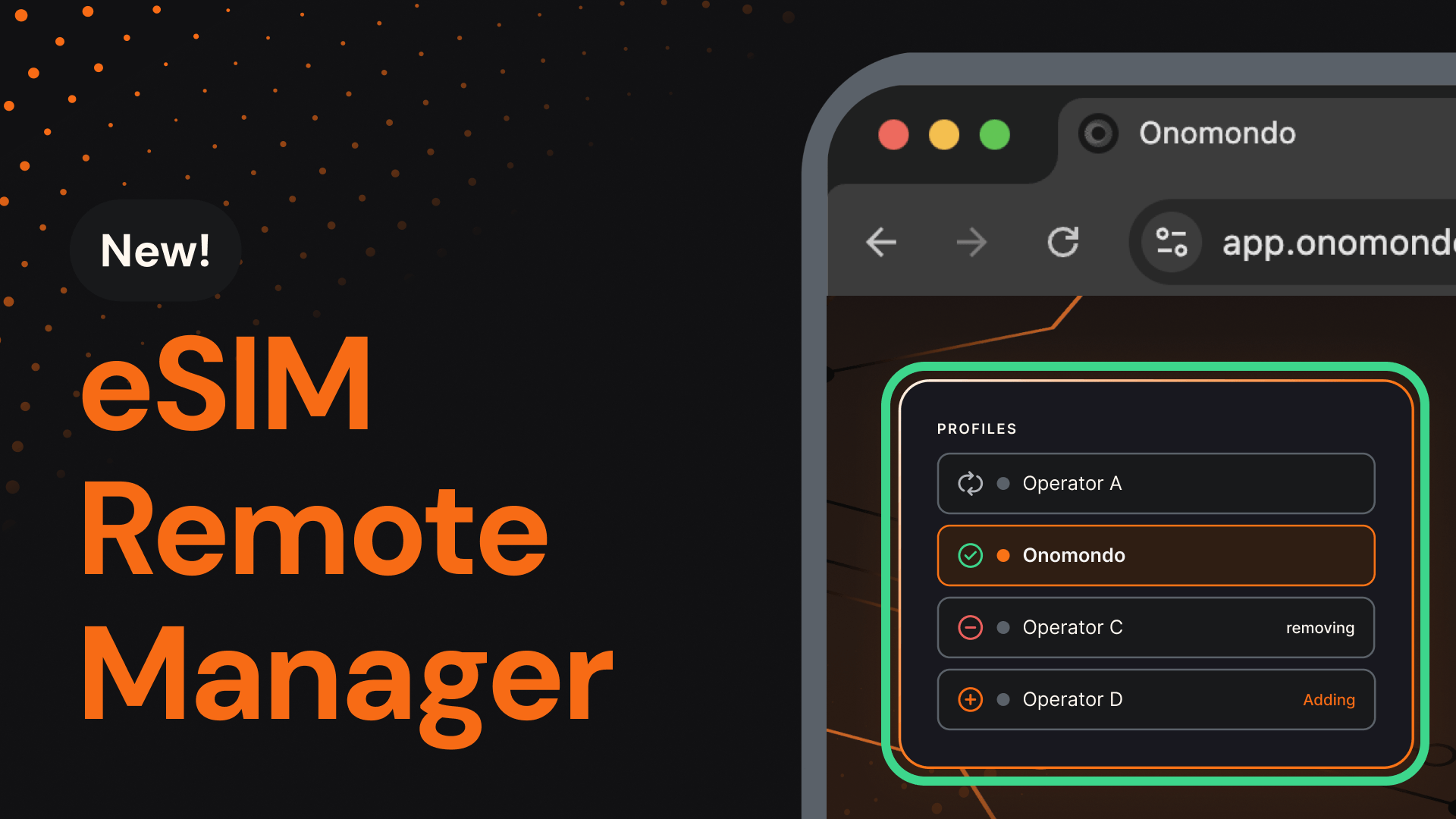
Onomondo offers both routes. Pre-provisioned eUICC SIMs arrive with profiles already installed, so devices leave manufacturing ready to connect. And SoftSIM drops the hardware entirely: no physical SIM to order, ship, or clear customs, and provisioning happens over the air.
The result is that connectivity stops being the thing that holds up an April pre-sale. You decide the form factor once, or design it out with SoftSIM, and the factory keeps moving.
Frequently asked questions
How long do IoT SIMs take to deliver?
SIM cards ordered in bulk, as IoT uses them, tend to carry long lead times, and customs can stretch delivery longer still. Together with import restrictions, that can push a launch back by months — which is why teams increasingly design the physical SIM out of the critical path.
What is a pre-provisioned SIM?
A pre-provisioned SIM has its network profile already installed and provisioned at the time the form factor is fitted in manufacturing. Devices come off the production line ready to connect, with no manual provisioning step afterward.
How does SoftSIM remove SIM logistics?
SoftSIM is a pure software SIM with no physical hardware, so there’s nothing to source, ship, or clear through customs. It’s provisioned over the air, which takes SIM logistics off the critical path altogether.
Why does form factor delay manufacturing?
Manufacturing at scale can’t start until the form factor is decided, because the boards have to be built for it — an MFF2 chip and a plastic SIM slot aren’t interchangeable. An unresolved form-factor choice stalls the production line.