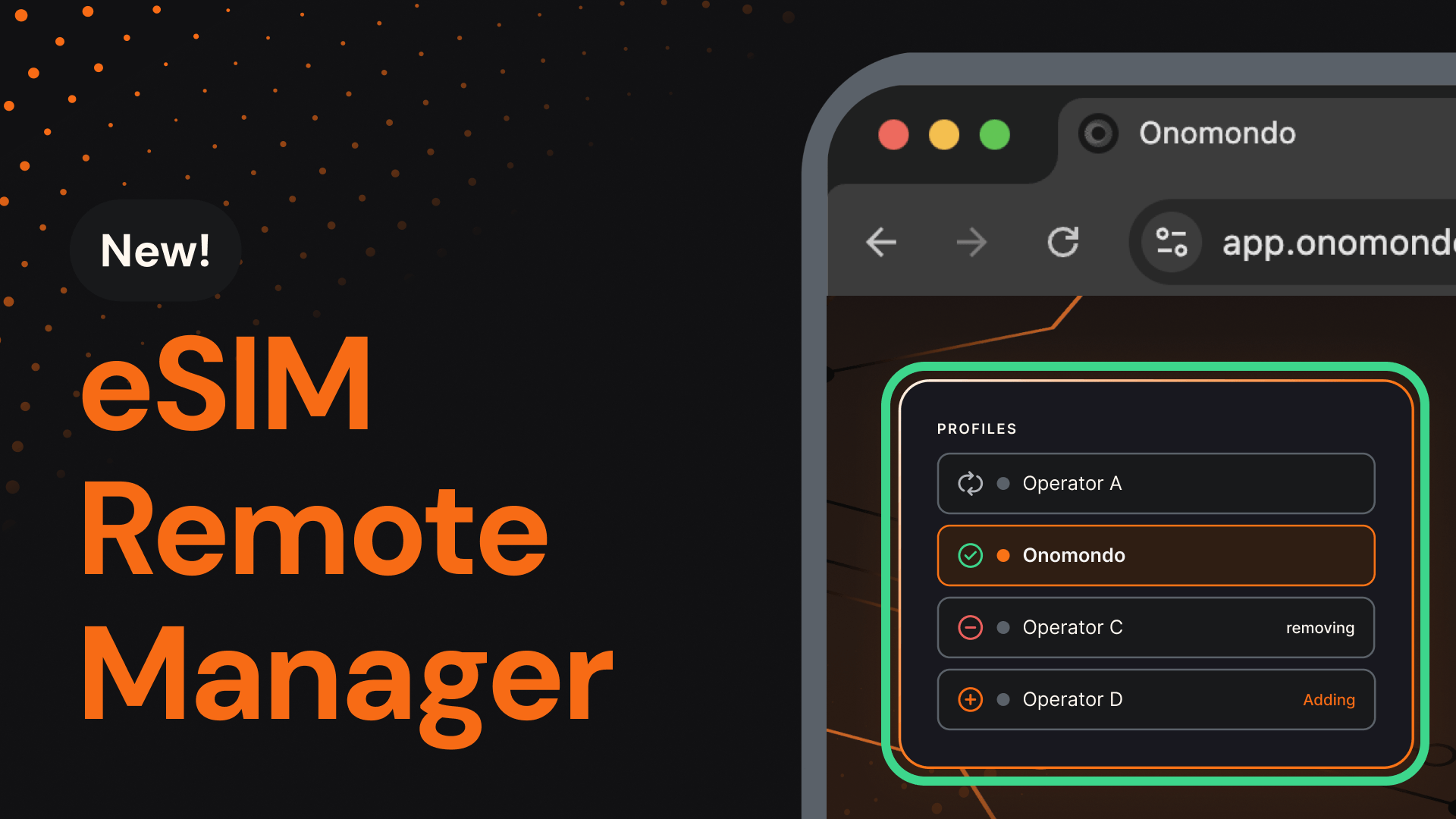
The IoT eSIM you actually control
Connect with a non-steered IoT eSIM on a network we own. Your device takes the strongest signal in each market, switches operators over the air, and stays yours to leave, across 680+ networks in 180+ countries.
One eSIM for every market you ship
Ship a single device design and assign the right operator per region remotely. Expand into a new market without a new SIM, a new contract, or a hardware variant, even where your current operator can’t follow.
View coverage in your region like Europe, APAC, North America, Latin America, and MENA.

It runs on a network that gives you visibility, scalability, and control
One profile, one SKU, one APN
Always on the strongest signal
Switch operators, never the device
Arrive connected from the factory
It’s infrastructure, not resale
Most providers resell another operator’s carrier deal. We built and run our own core network, which is what lets us give you the control, visibility, and freedom on this page.
ITU-approved MNO
RIPE-approved ISP
ISO 27001:2022 Certified
NIS2 Compliance
680 +
180 +
1
See into the network and every device
Catch issues before they turn into customer complaints. Skip support tickets and identify failing devices from live network data without escalation.
-
Live device status
-
Direct network-level access
-
Fewer issue escalations
-
Self-service troubleshooting
Cost that tracks usage, not surprises
You pay for the data your devices use and the devices that are on. Everything else stays off the bill.
Pay only for active data
Idle devices cost nothing
No roaming surcharges
Limits before, not after
You have the freedom to leave
You own every SIM and its keys. No lock-in periods, no exit penalties, no migration you have to negotiate for months. If we stop earning your business, you switch operators over the air, without recalling a single device.
-
You own your SIMs and your keys
-
Switch operators over the air, no site visits
-
Understand your options
-
Move to any GSMA-certified operator
What is an IoT eSIM, eUICC, and SGP.32 SIM?
To one person it is a soldered chip, to another a SIM that holds many profiles, to another a provisioning standard. Here is how the terms fit, and where our IoT eSIM sits.
| What matters at scale | IoT eSIM (Embedded SIM / MFF2) | eUICC SIM (SGP.02 / SGP.22 / M2M) | SGP.32 |
|---|---|---|---|
| What it is | A form factor: a non-removable chip soldered to the board. | The capability of a SIM that holds multiple operator profiles, and switches between them remotely. | The GSMA standard that defines how profiles download and switch remotely, in bulk, on constrained devices. |
| Swap operator OTA? | It depends on the software loaded onto it; UICC or eUICC. | Yes, but requires in-person activation. | Yes, designed for it. |
| How a swap works | Profile are set at manufacture; replace or potential for OTA to change. | Operator-driven push; relies on SMS and heavy SM-SR backend | Managed remotely by an eIM; no device screen or SMS needed; works on NB-IoT and LTE-M |
| Governing spec | None (a form factor, not a standard) | GSMA SGP.02 | Limited, varies by provider |
| Best for | Depends on the software. | Existing M2M fleets that don’t need to switch operators. | New large-scale, headless, global IoT wanting flexible, future-proof control |
IoT businesses enabled by Onomondo
Ken West
Reefer Digital Development Manager
Mads F. Gregersen
Founder
Thomas Pedersen
Founder & CEO
IoT eSIM, SoftSIM, or physical SIM?
One connectivity infrastructure underneath all three. Pick the form factor your hardware needs.
Physical SIM
-
2FF Mini
-
3FF Micro
-
4FF Nano
-
MFF2 Solderable
IoT eSIM & SGP.32 FAQ
eUICC is the capability to hold multiple operator profiles and switch between them remotely. An eSIM (MFF2) is a non-removable form factor. SGP.32 is the GSMA standard that defines remote provisioning for IoT. A SIM can be all three at once, because they describe different things.
Often, yes. “eSIM” frequently just means the solderable MFF2 chip, and we ship that today on the global IoT SIM, with or without multi-profile capability. Not sure which you need? Tell us what you are building.
SGP.32 is the GSMA capability for remote SIM provisioning in IoT: downloading and switching operator profiles on deployed devices, in bulk, with no screen and no user in the loop. It replaces the operator-controlled M2M approach (SGP.02) and the consumer one built for phones (SGP.22). Our SGP.32 SIMs are available today.
Not with us. With SGP.32, your profiles are managed through an eIM, and many vendors quietly tie your SIMs to theirs. That is where the lock-in usually hides. We keep our approach open, so the control point stays with you and you can keep your own SIMs, profiles, and operator relationships.
All of it. Embedded MFF2 SIMs with a single profile ship on the global IoT SIM. For multi-profile, we offer both flavors of eUICC: SGP.22 in production, and SGP.32 available today. Every SIM ships preloaded with an Onomondo profile, so devices arrive connected. Tell us your fleet size and we will map the right path.
Often, no. An Onomondo profile is not tied to one network, and the Network Marketplace changes which networks devices use without touching a profile. Most fleets never switch. The eUICC is insurance, freedom you own even if you never use it.
Profiles are loaded at manufacture, so devices arrive ready to connect. Switching after deployment is what the SGP.32 standard defines, through its eIM and on-device IPA components. Tell us your fleet, hardware, and rollout plan and we will map the provisioning path that fits.
All three run on the same Onomondo network with the same visibility and controls. A physical SIM suits mixed and refit fleets, the eUICC adds remote operator switching, and SoftSIM removes the card entirely. See the global IoT SIM and SoftSIM pages.
Get in touch
Interested to hear more about our IoT SIMs and global coverage? Get in touch by filling out the form.
Australia (English)
German
Italian
Spanish
United Kingdom (English)