

An IoT SIM management API gives you programmatic control over your fleet’s connectivity: activating and deactivating SIMs, selecting networks, and pulling usage reports through code instead of a dashboard or a support ticket. At a few hundred devices, that’s a convenience. Across thousands of SIMs, it’s the difference between scaling and drowning.
This one can read as niche, even too technical to matter. But in fleet managers’ own words, it’s anything but — it’s one of the most characteristic woes of a fleet that’s actually scaling, and one of the nine reasons IoT fleets switch connectivity providers.
Here’s how the manual-management tax adds up, why most providers never build the automation, and what a tech-forward platform looks like.
The daily tax of manual SIM management
Fleet managers tell us they often end up building the fleet-management capabilities a large fleet depends on in-house, with their own engineering resources. That choice alone shows how much efficiency is locked up in those capabilities — but it’s still expensive, it’s time rarely well spent, and it’s only an option if the engineering resources exist at all. When they don’t, the alternative is provider support: request the feature through a ticket and wait. Sometimes the answer is slow. Sometimes it never comes.
At scale, the small things compound. Activating and deactivating SIMs, selecting networks, pulling usage reports — nice-to-haves, even luxuries, for a fleet of a few hundred — become a daily tax across thousands of SIMs without bulk actions and proper categorization. When the platform can’t do that work in bulk, the savings that should come with scale never materialize; instead, the margin of scale gets eaten by the resource it takes to manage the scale.
“We have zero visibility or automation from our provider; activating/deactivating SIMs and getting usage reports requires manual work and support tickets. Managing multiple operators without bulk APIs forces us into spreadsheets and manual uploads — it blocks scaling.”
The more mature teams want to go further still: to react to events as they happen, or get ahead of them, rather than polling for problems themselves. At that size, alerts, integrations, and APIs stop being conveniences and become an outright need.
Why don’t providers build this?
This is a double-pronged problem.
The first prong is structural. For an MNO, IoT — especially large fleets with diverse needs — isn’t the core business or the number that moves revenue, so it doesn’t get the development focus it needs. A marginal gain for the MNO is a massive efficiency gain and cumulative cost saving for a scaling fleet. The two sides value the same feature very differently.
The second is maturity and mindset. IoT-specific providers are often young and haven’t yet poured focus into exactly these capabilities, as they’re user-experience optimizations and segment-specific features. And it’s worth saying plainly: building bulk APIs, event-driven automation, and sensible categorization into the management experience takes a product mentality. A legacy telecom mindset, however capable elsewhere, tends not to think this way.
What a tech-forward platform looks like
Large fleet managers look for connectivity management platforms that are tech-forward, with a product offering that goes beyond data usage.
In practice that means three layers. Bulk actions and proper categorization, so activating, deactivating, and organizing thousands of SIMs is one operation, not a spreadsheet and a manual upload. APIs, so your own systems control connectivity programmatically instead of a person clicking through a dashboard. And event-driven automation — webhooks, alerts, integrations — so your systems react to what’s happening on the network as it happens, rather than polling for problems.
How Onomondo approaches automation
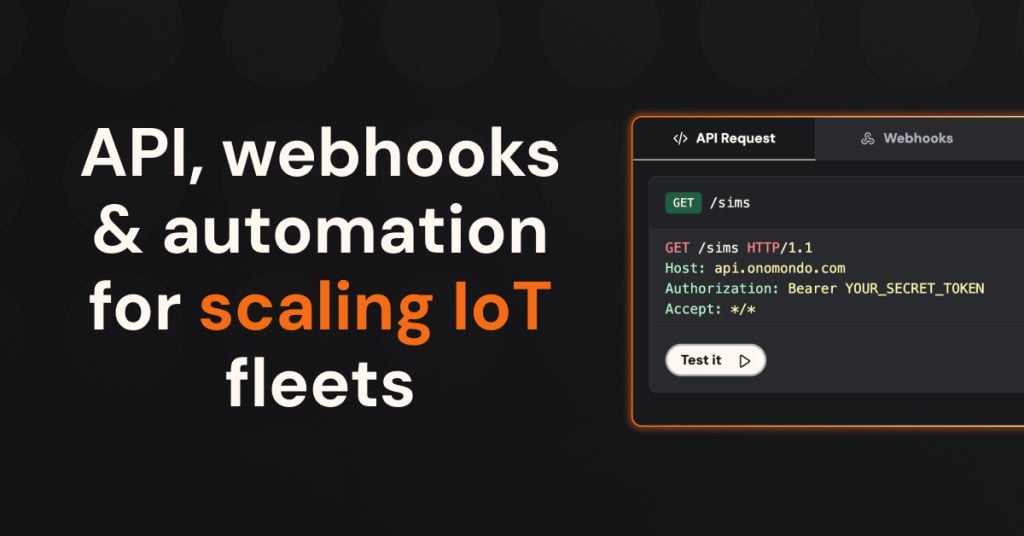
Onomondo is built with exactly that product mindset: a REST API for programmatic SIM control, webhooks for event-driven automation, connectors for your integrations, and bulk SIM actions for the work that should never be manual. The full reference lives at docs.onomondo.com/.
Automation also pairs naturally with visibility: the same platform that lets you act on your fleet programmatically should let you see what’s happening on the network in real time. For that side of the story, see ending the device-vs-network troubleshooting blame game.
Frequently asked questions
Can you manage IoT SIMs via API?
Yes — with a provider that exposes one. An IoT SIM management API lets your systems activate and deactivate SIMs, select networks, and pull usage reports programmatically, instead of through a dashboard or support tickets. Onomondo’s REST API is documented at api.onomondo.com.
What can you automate with an IoT connectivity API?
The work that becomes a daily tax at scale: activating and deactivating SIMs, selecting networks, pulling usage reports, and organizing SIMs with bulk actions and categorization. Mature teams go further with event-driven automation — reacting to network events as they happen rather than polling for problems.
How do webhooks work for SIM events?
Instead of your systems repeatedly polling the platform to check for problems, a webhook pushes a notification to your endpoint when an event happens — so you can react as it happens, or get ahead of it. At fleet scale, that shift from polling to event-driven is what makes alerts and integrations an outright need rather than a convenience.
Why don’t MNOs offer bulk SIM management APIs?
For an MNO, IoT isn’t the core business or the number that moves revenue, so these capabilities don’t get the development focus they need — and building bulk APIs and event-driven automation takes a product mentality that a legacy telecom mindset tends not to have.