

Network steering is when your provider decides which network your devices connect to. This is not a technical decision, but a commercial one: vendors steer devices onto their telecom partners’ networks rather than onto the strongest available signal. The result is weaker connections, more downtime, and costs that only show up later.
That last part is what makes steering expensive. The trade-off is invisible at the point of sale and obvious in the field — in dropped transactions, dead batteries, and access fees no one quoted you. It’s one of the nine reasons IoT fleets switch connectivity providers.
This guide explains how steering works, why devices get stuck on weak networks, and what a non-steered SIM changes.
What is network steering?
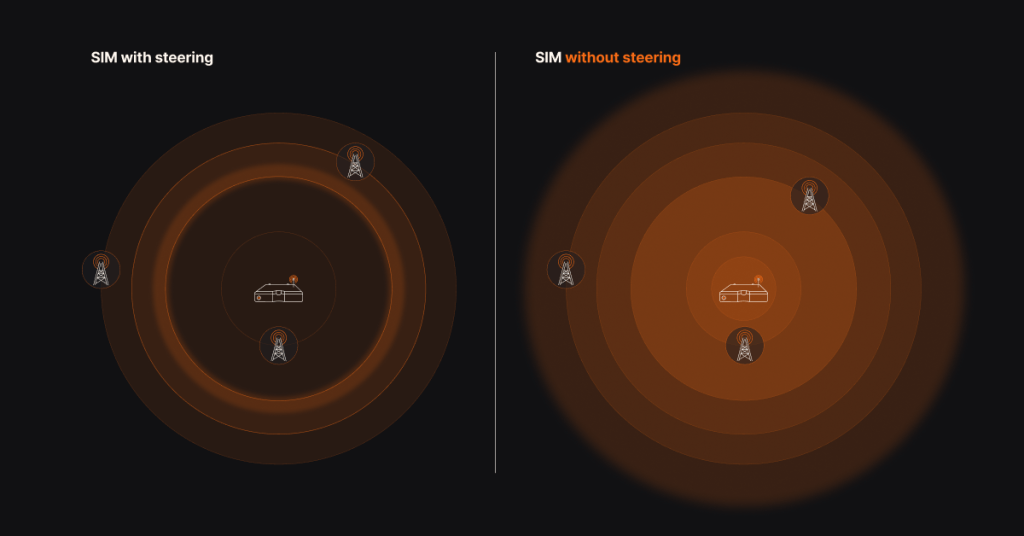
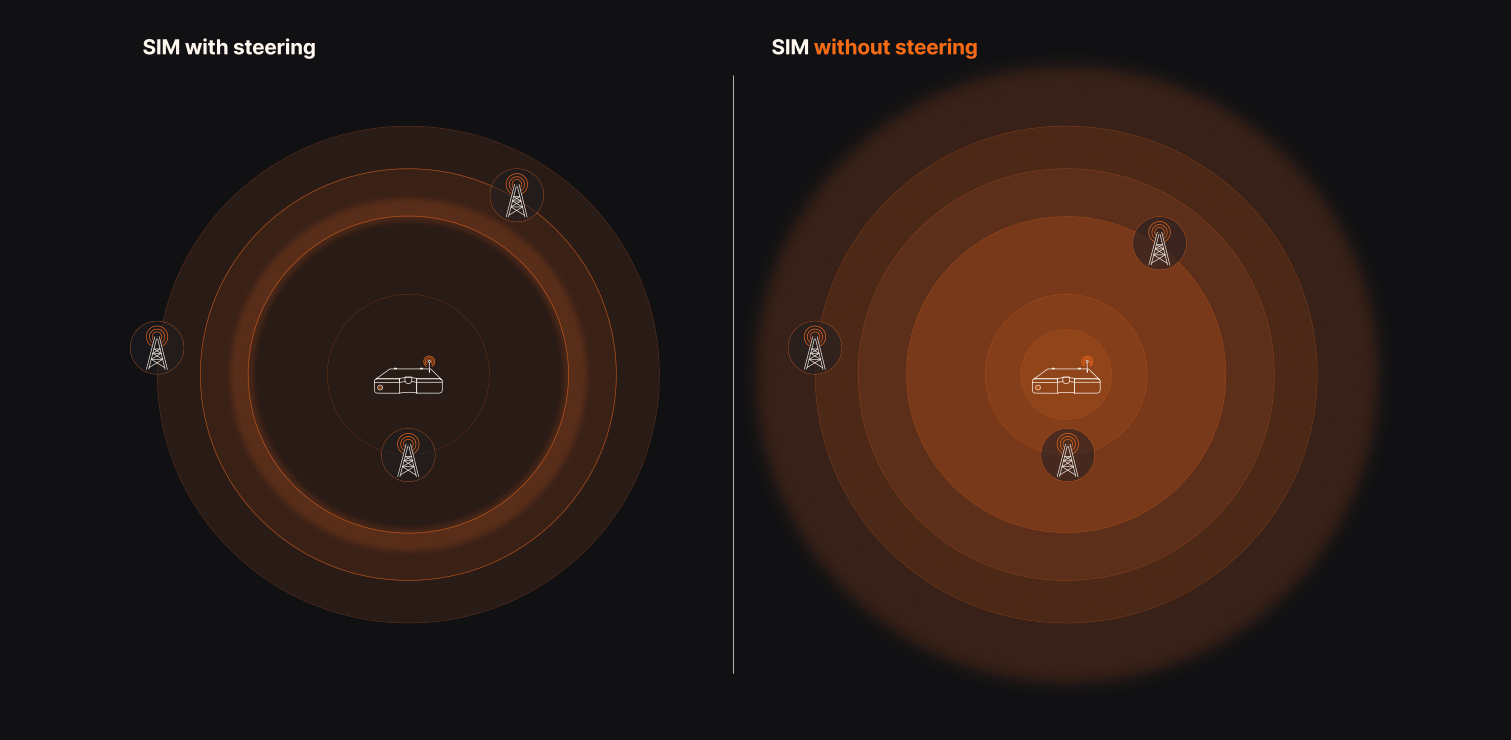
Steering decides which network a device attaches to. On a non-steered connection, the device connects to the strongest available signal wherever it is. On a steered connection, the provider overrides that and points the device at a partner network it has a commercial relationship with — even when a stronger network is sitting right there.
The reason is straightforward: providers pay less to run traffic over their own partners. Steering protects their margin. It rarely serves the device.
The effect is most prominent in roaming, and even more prominent on MNO-connected devices, where the roaming partner networks are fixed. When the partner list is locked, a device that lands on a weak network has nowhere better to go.
How does steering show up in a fleet?
You usually see the symptoms long before you name the cause. A fleet manager watching a steered deployment tends to describe some version of the same thing:
“Our current provider forces devices onto cheaper network partners of theirs and the devices stay on weak networks — payments drop and merchants lose revenue.”
The mechanics behind that complaint take a couple of forms. In one, a provider’s steered connection causes operator switching in roaming to fail, resulting in costly device downtime. Sometimes that means complete outages; sometimes, less severely, devices fall back to receiving only partial data. Partial data is the worse of the two, because nothing looks obviously broken.
In another, when the device has a weak connection and maintains it due to steering from the operator, the device keeps retrying the connection. Those repeated attempts drain the device’s battery and lead to long outages.
Why do IoT devices get stuck on a weak network?
Because the network they’re on wasn’t chosen for signal strength. It was chosen for commercial reasons.
A non-steered device is free to select the strongest signal available. A steered device isn’t — it’s held on the partner network whether or not that network is the best one in range. Because the connected network isn’t the strongest one available, the connectivity is unstable: weak signal at best, and at worst dropped packets or failed cross-border roaming.
This is the part most providers don’t explain, because the explanation isn’t flattering.
Steering isn’t a coverage limitation or a technical constraint you have to accept. It’s a routing decision made on the provider’s side, for the provider’s benefit.
The hidden costs of steered SIMs
The headline cost is downtime. Underneath it sit three more that don’t appear on any quote.
Battery drain. A device stuck retrying a weak connection burns power doing it. For battery-powered devices in the field, steering doesn’t just cause outages — it shortens the deployment’s life between service visits.
Surprise access fees. Every time a steered device hops onto a partner network, that hop can carry an access fee. As one executive put it, the constant reconnection attempts have triggered repeated access fees, and the bill shock that followed.
Lost revenue while it’s happening. When payments drop, merchants lose sales; when a tracker goes dark, the asset is unaccounted for. The cost isn’t only the connectivity — it’s the outcome the device was deployed to deliver.
These add up to a real bill. For one executive the problem was such a blocker that they ended up physically replacing the SIMs across their fleet — a field operation that costs far more than the connectivity ever did.
Steered vs non-steered SIMs
The difference comes down to who chooses the network.
A steered SIM hands that choice to the provider, which routes the device onto its partner networks. Coverage and stability are whatever those partners happen to offer in a given place — and when the device is roaming or locked to a single operator, there’s little room to escape a weak one.
A non-steered SIM — sometimes called a multi-network SIM — hands the choice back to the device. It connects to the strongest available signal, reselects when conditions change, and isn’t held on a network for anyone’s commercial convenience. For a fleet that has to work everywhere its devices land, that’s the difference between coverage you can count on and coverage you hope for.
How do you stop network steering?
Fleet managers who’ve felt the full cost of steered connectivity tend to do three things when they redo it.
First, they look to deploy their next generation of devices or launch in new markets on non-steered connectivity, so each device connects to the strongest available signal.
Second, they complement it with real-time logs, so they can troubleshoot faster and on their own in the case the connection is weak.
Third — the more cautious, wary of landing in the same place twice — often run a PoC or pilot to validate a prospective provider’s network stability first, building a quantitative case with downtime KPIs to support the switch.
How Onomondo removes steering
Onomondo owns and operates its own global core network. Most providers resell or roam on someone else’s core, which is exactly where steering creeps in. Owning the core is what lets Onomondo offer non-steered connectivity: devices connect to the strongest available signal on a single global network, not to whichever partner protects a margin.
The same foundation gives you real-time visibility into your traffic, so when a connection does look weak, you can see what’s happening and act on it — without opening a ticket and waiting for an answer.
The point isn’t the core network itself. As the fleet managers we talk to put it, no one cares about their connectivity provider’s core network — they care about seeing their data clearly, knowing what their fleet is doing, and being able to act on it. Non-steered connectivity is just what that looks like in the field. It’s also the simplest expression of a tenet we hold: fleet managers should be free to choose, free to control, and free to leave.
Frequently asked questions
What is network steering?
Network steering is when your provider decides which network your devices connect to. This is not a technical decision, but a commercial one: vendors steer devices onto their telecom partners’ networks rather than onto the strongest available signal.
What is a non-steered SIM?
A non-steered SIM lets the device connect to the strongest available signal wherever it is, instead of being held on a provider’s partner network. That means more stable connections and fewer steering-related outages.
How do you stop network steering?
Move to non-steered connectivity so devices select the strongest signal, add real-time logs so you can troubleshoot independently, and run a PoC with downtime KPIs before switching to validate a provider’s network stability.
Does network steering drain battery?
It can. When the device has a weak connection and maintains it due to steering, the device keeps retrying the connection. Those repeated attempts drain the device’s battery and lead to long outages.
Is a non-steered SIM better for IoT?
For fleets that need reliable coverage wherever devices land — especially across borders — yes. Connecting to the strongest available signal reduces downtime, battery drain, and the surprise access fees that come from bouncing across partner networks.