

PTCRB certification is the ticket onto North America’s biggest cellular networks. If you build cellular IoT devices for the US or Canada, you most probably need it. Here’s what PTCRB is, whether it applies to you, and how to get your IoT device certified without the headaches.
Table of Contents
What is PTCRB?
PTCRB is the certification your device needs before big North American networks like AT&T and T-Mobile will let it connect. The PTCRB certification acts like a network visa for some North American operators on your device’s passport.
Before a phone, tablet, module, or IoT device can use a cellular network in the US or Canada, it has to prove that it follows the rules and won’t cause problems for other users. PTCRB is the program that checks this.
North American network operators created PTCRB in 1997, and CTIA Certification, the certification arm of the US wireless industry group CTIA, runs it today. CTIA Certification also issues the certificates.
What PTCRB is not
It’s important to note here that PTCRB is not a law or a regulation – it’s a certification asked by some North American network operators. Other North American operators, like Verizon, run their own programs and most operators outside North America request GCF (Global Certification Forum). What is required by law for any radio device is the FCC Equipment Authorization in the US and the ISED Certification in Canada which involves a Technical Acceptance Certificate (TAC) issued by an ISED-recognized certification body.
Who needs to get PTCRB-certified?
In short, PTCRB applies to all cellular devices that operate in North America and connect to certain operators. In more detail, anyone making –and not buying out of the box–IoT devices that:
- connect to a cellular network (LTE, LTE-M, NB-IoT or 5G),
- will run in the US or Canada, and
- will connect through operators like AT&T, T-Mobile, Rogers, Telus or Bell, directly or through a provider that uses their networks,
needs to be PTCRB-certified or IoT Network Certified, its lighter version for IoT devices. If all three are true, then PTCRB is relevant for you. If your device connects with Wi-Fi, Bluetooth, or LoRa only; if you don’t plan on deploying in North America ever; or if you have an exclusive relationship with Verizon, then PTCRB may not be something you need to do.
Do I need a PTCRB certification even though I’m not an AT&T or T-Mobile customer?
Short answer: yes – if your devices ever run on AT&T or T-Mobile’s networks.
If you sign a contract directly with AT&T or T-Mobile, they’ll ask for your PTCRB certification before you sign. However, some IoT companies aren’t direct customers of AT&T or T-Mobile but they connect through another provider, like an MVNO or a roaming partner, that uses AT&T or T-Mobile’s networks. In that case, it may be your MVNO or roaming partner that asks for it.
My MVNO says I don’t need PTCRB – is that true?
Short answer: If you plan to deploy in North America, it’s not true – you still need PTCRB.
If you’re deploying in the US, get your devices PTCRB certified, whoever your connectivity provider is. AT&T and T-Mobile expect their partners to meet the same standards they’d ask of direct customers. If an uncertified device misbehaves on their network, they wouldn’t penalize the device maker – they’d penalize the device maker’s connectivity provider. Penalties may include losing access to the network altogether, and that hits every device your provider connects, yours included. Your provider carries that risk on your behalf, so asking for PTCRB certificate is a fair ask.
How does PTCRB work for IoT devices?
The good news for IoT devices is that they don’t have to go through the full PTCRB certification themselves. That’s because the modules bear the heavier load of the PTCRB certification. So if your device uses a cellular module that’s PTCRB-certified (all of which are listed here), you go through a lighter, cheaper version called IoT Network Certified.
“IoT Network Certified” is what the network operators will ask from a device manufacturer to answer the question “are you PTCRB-certified?”. So to prove your “yes” as a device manufacturer, you need to provide the IoT Network Certified plus the PTCRB certification of the module you used, which already exists. The module has already passed most of the tests, so you only prove you built it in correctly.
All the entities involved in PTCRB
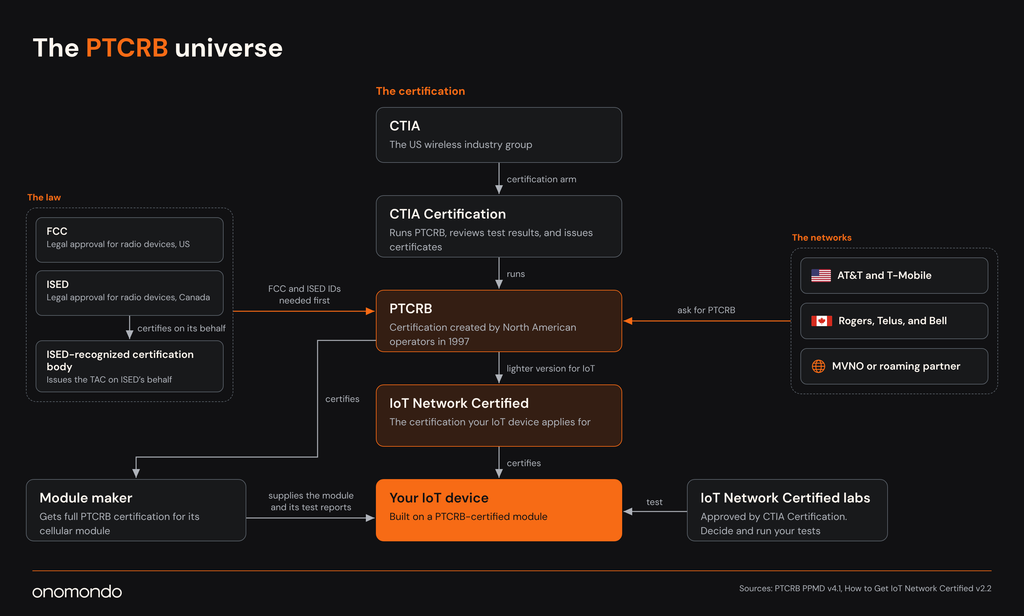
What does the PTCRB certification process look like for IoT devices?
The law comes before PTCRB. As we covered above, every radio device sold in the US must be FCC-approved, and ISED-approved in Canada. Your device can’t get a PTCRB certification without both. But the good news is the processes can run in parallel. You can start PTCRB before your FCC and ISED approvals come through. You just need the IDs before PTCRB certifies your device.
From then on how fussy or fussless the IoT Network Certified process is for you depends on how early in the design phase you incorporate the PTCRB-thinking. Picking a PTCRB-certified module and defining sharply how your device operates will make a big difference on how quickly and simply you will tick the IoT Network Certified box.
Phase A: Design
- Pick a PTCRB-certified module from the IoT Network Certified directory.
When choosing a module with a PTCRB-lens, check three things:
- The module covers the frequency bands you need.
You can switch bands off later, but you can never add new ones.
- The module’s certification isn’t about to expire.
Check when the module was certified. Devices can only build on a module’s test results for three years, as long as it runs the same software. Pick a recent one.
- The module maker can and will share its test reports with your lab.
The module maker’s PTCRB certification is part of the IoT Network Certified process.
- Incorporate the module per the IoT Network Certified rules.
A few design choices decide how much testing you’ll face later:
- Use the antenna setup the module was approved with.
The module maker got FCC and ISED approval for the module with a specific type of antenna and under specific conditions, like how close the device can sit to a person’s body. If you follow those conditions, you can reuse the module’s approval. If you change them, the approval may no longer cover your device. If you change the antenna, then you’d need your own FCC and ISED testing. - Power the module at the voltage it was certified at.
- A SIM card slot may add a testing round requirement. A soldered SIM chip (MFF2) skips a round of SIM tests.
- Leave voice calls off unless you really need them. Voice may add an additional test round.
Phase B: Pre-testing
- Have your FCC and ISED IDs ready.
These are the approval numbers the FCC and ISED give your device. You’ll enter them in your PTCRB request, and you can’t get certified without them. If you use the module exactly as approved, you can often reuse the module’s IDs.
- Choose an IoT Network Certified lab
Only labs approved by CTIA Certification can test for IoT Network Certified. Ask two or three for a quote and a timeline. The lab also decides which tests your device needs.
- Create your account and submit your request.
Sign up at certify.ptcrb.com with your company email. Then submit a request with:
- your model number (one per device)
- a product photo and a short product description of your device
- the module’s model, hardware and software versions
- your device’s own hardware and software versions
- your FCC and ISED IDs
- your chosen lab
Once the lab accepts the request, you can’t edit it. Double-check everything first.
- Sort out your IMEI number
Every cellular device has a unique IMEI. If you’ll make fewer than 100,000 devices over the product’s lifetime, you can use the module’s model code, i.e., the first 8 digits of the IMEI. If you’ll make more, you request your own.
- Pay the fee
IoT Network Certified costs $1,500 and the lab charges its own fees on top.
Phase C: Testing
- The lab tests your device
Because the module has already passed most tests, the lab only checks your build. Usually that means:
- Radio emissions
This test checks that your device doesn’t leak signals it shouldn’t and it’s always required. - Antenna performance
If your device connects often (more than 24 times a day) or sends a lot of data. - SIM tests
If your product design uses a SIM card slot instead of a soldered MFF2 chip.
After performing all the tests, your lab will upload the results, and CTIA Certification reviews them.
Phase D: Certification
You’re certified once CTIA Certification approves your test reports, your test reports, after you submit your documents, sign the license agreement, and pay the fee.
- Obtain your documents
Download your certificate and logo from your account. Your device appears on the PTCRB and IoT Network Certified websites. You can delay publishing your PTCRB certification for up to 365 days, if you’re keeping a launch quiet.
- Get the approval of network operators
AT&T and T-Mobile both have their own approval steps that require your IoT Network Certified documents. Ask your operator what they need.
Phase E: Post-launch
The certificate you just obtained covers one exact version of your device. If you change something in your device, some additional tests may be required to keep your PTCRB certificate up to date.
- Keep your certificate current
You’ll need an update to your certificate if you:
- Change the combination of the hardware and software versions of the device.
In this case, you’ll need to file an update called ECO (Engineering Change Order), which you submit through your PTCRB account. Updates to your own app usually don’t need an ECO, as long as the module’s radio software stays the same. - Launch a new model.
If you do any tweaks to your certified device, such as new casing or fewer bands, you can file for a variant certification for a fee of $1,000.
Bigger changes, like a new board layout or a change in the power circuit, require a new initial certification.
Conclusion
PTCRB, like any compliance issue might we add, looks scarier than it is. For most IoT devices, it comes down to a few smart choices made early: a certified module, an antenna that matches its approval, and a design you’ve pinned down before testing starts. And once your device is certified, the real work starts: keeping it connected, wherever it ends up.