

Ready to enter the eSIM IoT market? One word of advice: Don’t jump straight into it – take a few minutes to read this guide. Our short eSIM IoT buyer’s guide ensures that you get the best possible solution for your needs, navigates you through the market, and lists questions to ask the prospective vendors.
Table of Contents
I. Is eSIM IoT saving you or costing you?
Besides who holds the connectivity power, eSIM IoT flips the use case conversation equally. So when the question is “Who is eSIM IoT appropriate for?”, the answer is not specific industries or use cases but design and operational requirements.
So if the following requirements are essential or even top priority for you, then eSIM IoT can be a saving.
Savings opportunities
1. Operational pricing
For use cases with extreme sensitivity to pricing, eSIM IoT provides the agility to utilize price margins to your advantage. A stellar example is smart meters: Albeit local in their operations and economical in data transmissions, smart meter providers usually compete in tenders. In these cases, pricing is the main selection criterion, so when a smart meter vendor is able to provide the lowest cellular cost possible by playing the connectivity vendor field, it may secure them the tender.
However, it’s important to keep in mind here, that eSIM IoT will consume more operational data compared to a UICC, as the SIM is polling for eIM commands –and consuming data while doing that– at regular intervals. So if you’re fixed on eSIM IoT, ensure the deal you are getting scales with your fleet as well as its operational costs.
→ If you’re not 100% certain that eSIM IoT is the only solution, check out our reality check on eSIM IoT and alternative solutions.
2. Flexibility
eSIM IoT allows operators to manage network profiles at scale with a single SKU. This means that operators can deploy anywhere in the world and at any point in time, regardless of what profile they will use during operations. This way, not only do you get the flexibility to swap profiles and select vendors any time, but you can also circumvent roaming costs and restrictions by switching to local operators in countries with rigid roaming requirements. And what’s best, you can manage this swap quickly and easily, since it’s a single SKU.
3. Fallback
Critical devices need a fallback network. Before eSIM IoT, this was possible with a dual SIM, but it came with a large tradeoff: More space on the PCB, higher manufacturing cost per device, higher operating cost. Since eSIM IoT is an eUICC, it can host several profiles, so the device can come pre- or post-loaded with an additional profile in the same SIM as a fallback.
4. Savings at a large scale
This requirement is twofold: It can apply both to the number of devices and the ability to scale the fleet as well as the connectivity cost of the fleet. Here’s an example: Say you deploy a fleet of 1,000 devices in 2026 with provider X for the price of $0.5 cents per GB per SIM. If in two years, your fleet scales to 5,000 devices, it is almost certain that connectivity providers X, Y, and Z will be able to offer you a lower price per GB per SIM. With eSIM IoT, you can instantly switch to the better offer and compound the substantial savings for your entire fleet.
Cost risks
And here are some requirements that do not necessarily require eSIM IoT and can be solved in a simpler, more direct way.
1. Global scale
If you want to deploy in several countries in the world, you might be better off with a single vendor that provides access to multiple networks. This way, you can avoid roaming or selecting a local provider for every country –with the exception of very few countries– and skip the complexity of managing the eSIM IoT ecosystem.
2. Manufacturing prices
Certain devices, like single-use devices, need to be as cheap as possible – but in manufacturing, not operations. In cases where the BOM is critical, using a softSIM saves you the cost of SIM cards -embedded or not- altogether.
3. Ultra-power efficiency
Remote SIM Provisioning enabled by the eUICC puts extra power requirements to an eUICC-run device. This means that managing SIMs remotely consumes more energy from the device. So it is up to you to prioritize between the tradeoff of utmost power efficiency and utmost flexibility on connectivity.
II. What are you shopping for?
eSIM IoT is an ecosystem of products and services that work together. The ecosystem comprises of:
- The eUICC + form factor (the SIM): The software that supports multiple profiles and remote SIM provisioning and the hardware –the chip– that the software runs on.
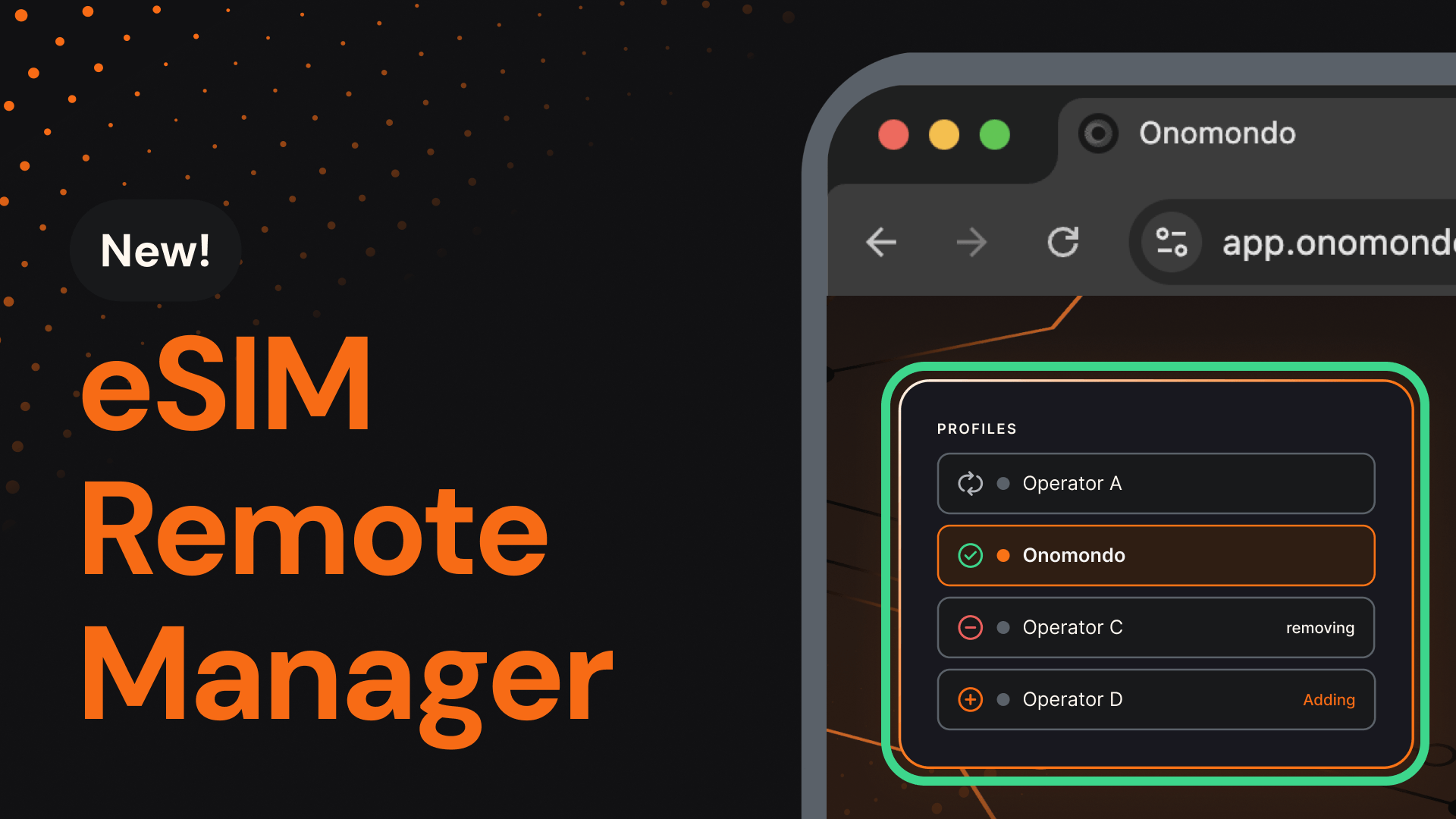
- The eIM: The eSIM IoT Manager; the control panel where you manage your SIMS remotely.
- The connectivity profiles or SM-DP+: The server address where profiles are downloaded from. In commercial eSIM IoT discussions, it is often used interchangeably with the network profiles.
→ Moving too fast? Check out the eSIM IoT buyer’s list with more detailed information about each component.
Depending on your requirements, you may buy the components from one or multiple vendors. All these components are interoperable per the standard, but if future-proofing and flexibility are top requirements for you, you should also ensure they are are interchangeable – on top of just technically interoperable. Which already inaugurates the eSIM IoT vendor questions.
Navigate the SGP.32 buying journey with confidence
Over 90 pages with a single goal: to level the playing field with eSIM IoT vendors. Our complete eSIM IoT buyer’s guide is your SGP.32 map from exploration to procurement.
III. What to ask when shopping for eSIM IoT
Organizational
1. Why do we need eSIM IoT?
The first question is to none other than yourself and your team. Managing a fleet with eSIM IoT solves many problems but adds complexity. Make sure that you are prepared to embed connectivity management into your fleet operations. Savings from eSIM IoT require managing multiple agreements and being proactive with your network choices. So make sure you know what you’re stepping into, scope the extra costs, and ensure that this investment will bring a return for you.
→ This one question for you and your team is absolutely not exhaustive. Bring this list of five internal questions to your next product design meeting around eSIM IoT and take decisions strategically and firmly.
Technical
2. Are all components interchangeable? / Is the eIM interchangeable?
This is a critical question, particularly to your eIM provider, and it is critical that your provider replies with a resounding Yes. A non-configurable eIM would mean that you cannot change eIMs – and potentially the choice of profiles available via this eIM may be limited. This also means that you are again in a vendor lock-in – but the eSIM IoT version of it.
3. Are these SIMs locked into a specific eIM?
The eSIM IoT version of lock-in is not a lock-in to a connectivity provider; it’s a lock-in to the SIM provider. When you initially purchase SGP.32 supporting SIMs, make sure they are not exclusively tied to a specific eIM – and the pricing of that eIM, for the lifetime of your fleet. If you haven’t made a decision on IPAe or IPAd but you’re ordering SIMs, ask also whether the IPA is in the eUICC (IPAe) or you need to install it on your device.
4. Can I download any and all profiles from your eIM?
The SM-DP+ and the eIM have to speak the same language to work with each other – that’s being interoperable. So if you already have a connectivity vendor in mind and are out shopping for the eIM, you can explicitly ask your prospective eIM vendor if their eIM is compatible with your selected connectivity providers’ SM-DP+ or keep it open and ask whether you can download any SM-DP+. If the answer is yes, it’s also worth the follow up question: “Have you tested it?“.
Commercial
5. What does the subscription for the eIM look like?
While SGP.32 does not technically allow for a vendor lock-in, commercial agreements do. So you may find yourself contractually obligated to pay for an eIM for a contractually specified time period – whether you use it or not. Moreover, some eIM vendors have an initial, one-off setup cost for the eIM which can be quite sizeable, so ensure that it is explicit and included in the pricing offer.
6. Are there costs associated with changing profiles in your eIMs?
Currently the eSIM IoT ecosystem market has a lot of implicit costs that are additional to the eIM, such as costs associated with uploading profiles and switching profiles. This would mean that every time you want to upload new profiles or swap profiles, you might be accruing a monthly bill. Ask the question explicitly to get an explicit answer.
7. Do you provide SM-DP+ profiles? And, what is the cost?
This is a question for your connectivity vendors and it checks for costs additional to the operational, data consumption charges. Connectivity vendors that provide SM-DP+ profiles are SGP.32 ready and already connected to eIMs. However, the costs for SM-DP+ differ as the eSIM IoT market is still taking form.
Key takeaway
The aspiration with this guide and list of questions is that they will help you navigate an emerging market where the norms and benchmarks are being formed as we speak. The key takeaway for buyers is this: Yes, you need some understanding of the ecosystem components but these are fixed and defined in the standard. However, the commercial model of eSIM IoT ecosystems and individual products is not yet fully transparent as it’s not yet stable. The pricing models are still emerging, defined differently by different vendors, and the commercial model is forming now.
Here’s what you absolutely need to know about eSIM IoT now, as someone actively in the market: Are the benefits of eSIM IoT an absolute must for you now? If so, you are an early adopter and unfortunately, there is a premium for your group: the early adopter tax. As long as you are aware, you can make an informed choice – and you are always, always, entitled to transparent pricing so ask for the pricing breakdown in its full, glorious detail.