
You’ve probably heard a lot about eSIM IoT or SGP.32. It’s a really important topic and we at Onomondo are excited about it. At the same time, there’s also a lot of noise and promises. When the case is equal parts excitement and hype, it’s important to separate the wheat from the chaff. We wanted to make sure everyone has a full understanding of what’s so exciting about this technology, the potential of SGP.32, and to make sure that everyone has a clear picture of what we can expect in the years to come as eSIM IoT develops.
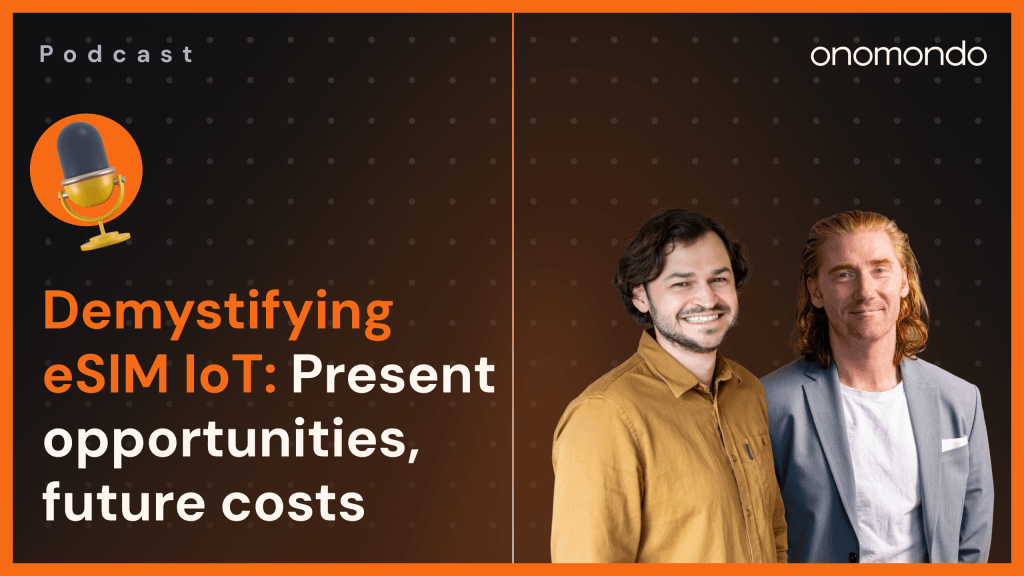
That’s why Connor Zazzo, Head of Brand Communications, had a heart-to-heart with Onomondo’s CTO and co-founder, Henrik Aagard. Connor asks Henrik everything one needs to know about eSIM IoT: What it is, which cases it is suitable for, and what to look out for when scoping the market. Hopefully by the end of this, everyone has a much better picture of what to expect from this technology and what questions they should be asking in the years to come – we at Onomondo certainly did!
Would you rather have it in video? Watch the full interview with Henrik below:
– Let’s start with something simple. What are we actually talking about today when we’re talking about eSIM IoT? What does that actually mean?
That’s a very good question. eSIM IoT is an ecosystem and that’s the very first thing to be very aware of. It’s an ecosystem that our industry has bought into which is great. SGP.32 is a standard proven by GSMA, written by GSMA –technical specifications and how it should work. Everything has been accepted by the industry and that’s very important.
This ecosystem touches on operators, connectivity providers, as well as SIM vendors and customers so it’s everything coming together in a unified system that can play very well if implemented correctly.
– Why should anyone care about SGP.32 being implemented correctly? Why should people care about this ecosystem that’s relatively new?
There’s a lot of hype in the industry and a lot of it is driven by new technology. In the past years, we’ve seen innovation happening from the vendors, within the industry itself rather than maybe market demands. I think eSIM IoT is a good example of market demand and what the users need. We as an industry have listened.
When I mentioned the correct implementation, it can be one of the things that unlock a lot of new parameters that will accelerate adoption of IoT deployments. So it’s a benefit for everyone in the ecosystem.
– So it’s really about how people can deploy more, accelerating deployments. Going deeper into it, what’s the background of eSIM IoT? What problems was SGP.32 actually trying to solve?
Fundamentally it’s addressing vendor lock-in, which is one of the biggest barriers we have within the telecom industry specifically.
– Can you just define vendor lock-in for people who aren’t familiar with the term?
It goes all the way back to consumer devices and mobile phones. In the very early days when you bought a phone, it would be tied to a specific operator. To change that, you would actually need to change the phone. For the consumer version, where you have a human being at the other end, the SIM card came about to partially unlock that and make it easier for you to swap operators by swapping SIM cards – which pretty much everyone has tried to do!
Lately on the consumer side, we’ve had the consumer version of eSIM, which you know from the wearable watches or phones, where you can easily change your connectivity provide without physically swapping something. Before that you’d be locked in to that specific operator and that has changed.
IoT is completely different because we have physical assets out in the real world where often the business case doesn’t justify physically attending to it as a human being. So IoT has been hindered by the choices you make very early in the design phase and the build phase of the hardware and devices used. You’d make decisions on the vendors that you would work with for the lifetime of that unit.
eSIM IoT solves that – it removes this vendor lock-in. It might not unlock new use cases as such, but it might make the decision of actually venturing into IoT and industry digitization much easier, because you know you have the flexibility to change connectivity down the road.
Suddenly you have the flexibility to change your initial choices whenever it makes sense and that may be at any stage in the lifetime of IoT: in the early testing phase, development phase, manufacturing phase, deployment phase, post- deployment phase.
The world changes fast and the decision you make today might need to change 3 years from now. One of the things that we’ve seen a lot when it comes to some of the actual use cases eSIM IoT and SGP.32 being a way for better device insurance or to help with roaming.
– Can you talk a little bit about what “no more vendor lock-in” and “flexibility” actually mean in practice, for the customer, for the people deploying devices? What does that actually change in someone’s day-to-day?
The insurance model is maybe the easiest one to illustrate. It’s about the relationship and partnership you make with a connectivity provider when you’re designing and building your product. You can change that afterwards, maybe because the commercial model doesn’t fit in the long term, or three years from now the commercial model of connectivity changes and you want a different commercial relationship with someone else. You’re not tied to the business you chose in the beginning. There can be very different strategic reasons for changing things down the line.
On the roaming side, you might find a vendor today that fulfills all your needs. Maybe today you only sell to Denmark, Germany, and the US, and you find a connectivity provider that serves those markets. Then three years from now, it might be that either that operator can no longer serve a market, or you want to expand into a new one. Countries like Brazil and Turkey have specific regulations where you may need a direct relationship with a local provider.
Before eSIM, you would need to manufacture your devices specifically for those markets and put a physical SIM with a specific operator into those devices. Anyone who’s been in the industry and done hardware knows that manufacturing, logistics, planning, how many devices to allocate to which market, not being able to take a portion of these devices and reschedule it for another market… All of that can suddenly disappear, because now you’re able to change that within the existing hardware whenever it makes sense.
So it’s the flexibility it provides. Your needs might change, you might need to expand your business, or the operator you started with suddenly changes things so it no longer fits you as a customer. eSIM unlocks that.
– It also sounds like, through this consolidation, eSIM can do so much and fit all these different use cases, but there’s also a certain simplicity for the customer as well. It’s one platform, one SIM that enables all of this rather than switching to a new provider or vendor every time there’s a big business decision.
Yes. And in that regard, it’s very important to also not think of eSIM IoT as your connectivity necessarily. When you as a customer need to embed eSIM IoT, it shouldn’t be treated as connectivity. It should be part of the bill of materials. It should be part of the design choices in the build phase of the devices. You put eSIM capability onto your device, so that then you can choose your connectivity operator whenever the need is there. That might be one provider, or multiple, depending on your product and business case.
But eSIM IoT as a whole shouldn’t be seen as a connectivity product. It should be seen as something that you put on your device. It’s part of that mental picture so that you have the choices and the flexibility when needs change.
– Is this for every single use case?
Not necessarily. It fits a big portion of use cases, but eSIM comes with a cost, both commercially, and also in terms of power. It’s power-hungry and not as efficient as other solutions. So for use cases with very constrained devices or very short-lived devices, eSIM IoT might not be the right choice.
It very much depends on the use case, and whether the need for flexibility and freedom to choose between connectivity providers end-to-end actually fits the use case. Because it comes with a cost and people should be aware of that.
– Really good points on that. One thing there is something worth doubling down on. We talk about all these benefits, the potential use cases that can spur from correct implementation, the flexibility, and possibilities that can come from not thinking of eSIM IoT necessarily as connectivity but as an extra tool that makes IoT more possible. So why is there so much excitement around that? Because, I understand your perspective, but it’s blowing up in the news, in the industry – everyone’s talking about it daily. Why do you think that excitement is there?
IoT as a whole is becoming more and more mature, and a lot more people have felt the pain of not having eSIM – either businesses that have grown and found the limitations of their current connectivity relationships, or the world changing around them. The excitement is there because this technology really and truly unlocks and touches upon some of the barriers and challenges we’ve had in the industry. It’s driven by market demand; it’s driven by a genuine need. It hasn’t been innovation for technology’s sake. It was created because there was a specific need for it. And that’s what we’re seeing the market reflect back. That’s the excitement.
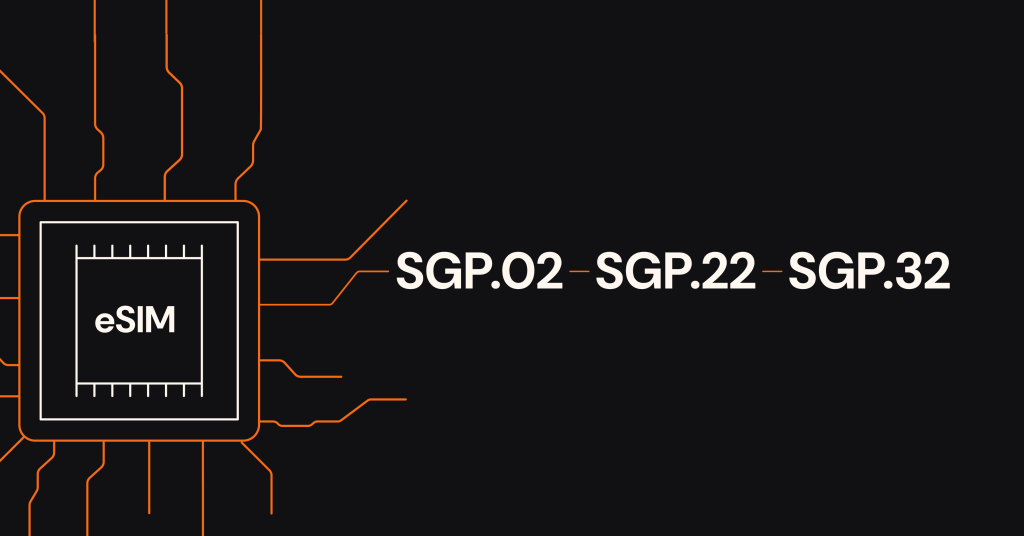
– That’s a great segue to another point. This new technology, SGP.32 was introduced back in 2023. What was actually new as part of this when we compare it to what existed before with SGP.02 and SGP.22?
eSIM IoT and SGP.32 are very much an evolution of the eSIM standard, or eUICC more technically. The early-days first attempt was for IoT, SGP.02 or the M2M version, that was not so much driven by market demand and from the customer and user perspective, but more from the industry itself. It was us trying to stitch together a lot of agreements into a single SIM, but driven by operators and the ecosystem. It had a ton of complications, commercially and technically, requiring a lot of implementation and investment from the industry as a whole. And massive investments tend to hold back adoption and acceleration. I think mentally a lot of people have deprecated that standard.
The consumer version, SGP.22 was a very successful one – the one we know from wearables, watches, smart phones, where we suddenly put the power in the hands of the customer, which is what drives mass market adoption: When you have a mass market that wants something, then adoption is definitely happening.
SGP.32 took the learnings from both the consumer eSIM and the old M2M version and tried to simplify as much as possible toward a proper IoT implementation. It’s an evolution based on learnings from previous standards, trying to remove the challenges we were hitting with earlier technologies, and specifically and purposely designed for hardware deployed without a human physically present to control it.
– Looking back at the biggest challenges that you were seeing and that we’ve heard from customers over the years too, what were those challenges that we weren’t able to solve before?
Adoption was a big one. The first version required adoption and investment from the whole operator landscape. And we’ve seen something similar with new radio access technologies like NB-IoT and LTE-M showing some acceleration and adoption but at a very slow pace, because it’s a massive investment from operators. The classic chicken-and-egg: do you invest before the market is there?
There were also technical complications. Operators needed to do individual technical integrations with every player who wanted to be in this ecosystem.
eSIM IoT has flipped that around. Instead of putting the burden and investment onto a limited number of operators, it puts the investment decision in the hands of the customer. If you want to make this investment as an individual customer, you can do so.
With eSIM IoT, we’ve addressed the barriers and challenges within this ecosystem, and hence there’s a big mass market of customers, OEMs, and others who really want to adopt it and are willing to make that investment. The power dynamics have shifted, which is very positive for an industry that’s being driven by proper demand.
– And there’s been a shift over the years too, from early SIMs in the 2000s where vendors had full control, to consumer eSIM where the end user could finally choose. I remember in the early 2010s when you had to buy a separate iPhone for Verizon or AT&T. We’ve come so far from that. It really feels like this is just the next step, continuing to give more control and agency to the company that’s managing not a couple of iPhones but millions of devices.
Exactly. And it’s always been a bit of a disease in our industry – and I can speak on behalf of it because I’m part of it! There’s been a hesitation from what I’d call the very few, whether it’s operators or other parts of the ecosystem, who really wanted to lock customers in to keep them.
That’s something we’ve been very much against at Onomondo from the very beginning. For proper acceleration and adoption in a mass market, we need to change that behavior. We need to provide tools and innovation that really fit the purpose, and then acceleration and adoption will come, which benefits the greater good. There will be more for the likes of Onomondo and other operators to serve. It’s about putting the power into the hands of the ones actually using it, with a tool that really fulfills their needs.
– I remember back when I joined Onomondo, one of the things that you mentioned in one of our first meetings is –you’re smiling, it is funny!– that there’s always a new standard in telco. It’s an extra port., it’s an extra technology and it’s always going to be “the One”. And it’s one reason why I wanted to have this conversation about SGP.32. Because it’s going to be here for a while.
People are making decisions now that are going to be part of their business for a decade or more to come. It’s important to go into the details around this and that people understand it from the very beginning rather than making a decision now and discover it doesn’t fit. So let’s expose as much as we can around it and let’s take a step back: SGP32, eSIM IoT, SM-DP+. Telco loves an acronym. What when we talk about eSIM IoT, what do we actually mean when we say eSIM? What is this SGP.32 eSIM IoT standard? How does it work? What are the different components of it?
I can definitely try. But to start with, I definitely agree – we have a tendency to make things amazingly complicated in our industry.
First and foremost, eSIM IoT is an ecosystem. There isn’t one eSIM IoT product. The ecosystem consists of mainly three elements and it’s an ecosystem of different vendors, providers, and customers.
As operators, like for us in Onomondo, instead of selling physical SIM cards, eSIM IoT is about making it much easier to switch connectivity. So what we sell are eSIM profiles. Technically, we do that through a service called an SM-DP+. That’s something the operator hosts, and that’s where we have our eSIM profiles for customers to download and use.
Then there’s still the physical SIM. eSIM IoT requires and mandates a physical SIM, whether that’s a plastic SIM, an embedded SIM, or another form factor. That’s what you put on your device to give it eSIM IoT capabilities. On that device you’re able to download profiles from operators via their SM-DP+, and you’re also able to communicate back to a platform to get instructions on which profiles to download or use.
And then there’s the platform called the eIM, that’s hosted on the internet. That’s where you manage your fleet of SIMs, which profiles to download, which to swap to, which connectivity provider to use where and how.
So there’s, more or less, three pieces to the eSIM IoT ecosystem. There’s the operators that have eSIM profiles on the SM-DP+; there’s the eSIM IoT-enabled SIM cards – the physical SIM cards that you put on your device, and there’s the eIM platform, where you manage all of this.
Ready for the ABCs of eSIM IoT? Sign up for the eSIM IoT email course and learn everything you need to know abou SGP.32 in 5-minute reads delivered in your inbox →
– So the idea behind it is that you don’t need to necessarily get all of it from one place either. You should be able to swap things around and build the solution that makes the most sense for you.
And that’s one of the reasons why not having a lock-in and actually having flexibility is so important for this to actually succeed – both as a technology but also as a tool for the end-customer. There are so many different IoT use cases, and business scenarios that need that flexibility of who they’re buying the SIM from, which platform they are using.
Yes, that’s exactly what one should be aware of. All three pieces need to be interchangeable at any point of time. You should be able to choose whatever operator or connectivity provider you want to use. You should be able to choose whoever SIM vendor you want to work with at any point of time. And you should be able to choose whatever eIM provider that you want to work with and change that at any point of time. That’s the flexibility eSIM IoT promises, if implemented according to the standard.
– In your dreams –which I’m sure you’re having about eSIM IoT!– when you think about where it actually goes in five or ten years from not when it becomes an interchangeable ecosystem, what do you imagine comes from it? What does it mean for the IoT use cases of today? How does it change how we build IoT?
First and foremost, it will be a big part of just accelerating the industry – maybe not initially just through new use cases, but because suddenly you can do IoT without needing to make choices that lock you in for the rest of the lifetime of that business case. This will unlock a lot of decisions that before were “maybe” or “no” and turn them into “yes.” We’ll be seeing companies doing much more of this. That’s the biggest promise I see from eSIM.
Then going forward, when it becomes much more of a standard and this is just how the industry works, unlocking new markets will become much easier, e.g., deploying in Brazil, which wasn’t easy before. So doing hardware as part of the solution, whether for gathering insights or selling that piece of hardware, the world becomes smaller because you can unlock new markets much more easily.
Those are the two big things: decisions become much easier to make, and as a company, new markets will unlock much more easily than before.
– That’s something that you’ve mentioned over the years and something that we talk a lot about within Onomondo: how to make connectivity invisible in some way – I don’t like the word “seamlessness” but maybe “frictionless” is it. Connectivity becoming infrastructure and much more than just a SIM card I need to connect. Can you put a few words on that?
Exactly, there is much more to it. Connecting a device is not just about choosing a connectivity provider. It’s a completely new exercise for a company or a user. Remotely distributed devices across a country or the globe, managing whether they’re performing well – that isn’t just buying a SIM card and plugging it into your phone. If something goes wrong with a smartphone, you reboot it and it works again. IoT is completely different.
IoT is not just about choosing a connectivity provider. It’s infrastructure you apply onto your whole solution. It’s a bit like deploying in the cloud and operating in a SaaS environment: you choose your cloud vendor, you choose all the managed services, you build proprietary things. There’s a lot more to it than just buying a server.
Similarly, IoT isn’t just buying a SIM card and connectivity. It’s the infrastructure and the ecosystem around connecting that product – everything from the modem to the eSIM IoT capabilities on your device, to your connectivity provider, to the insights you’re getting for remotely operating your fleet.
– What does that look like in practice? Someone could be out there and they’re looking for an eIM – the platform to manage this, they know they need the SGP.32 SIMs, they need their SM-DP+ to get those profiles ready. But that’s not a guarantee that they will have that flexibility. So what are the things people need to think about or look out for?
It’s a bit technical but very specifically, they need to make sure that the eIM is configurable, meaning the SIMs can work with any eIM platform, and the eSIM IoT platform and ecosystem can work with any SM-DP+, where operators host their profiles.
If there’s vendor lock-in anywhere in those scenarios, you might have chosen an eSIM IoT vendor, you have access to three operators, and that serves your needs today. But then you want to go to Brazil, and in that closed ecosystem there isn’t a connectivity provider that can serve Brazil. You might end up not being able to freely choose on your own, and the vendor you’re with might not have the interest or capability to make that happen.
Or from an eSIM IoT platform point of view, you have a platform where you manage your SIMs and connectivity agreements and fleet deployment, but you want to change your SIM vendor or the functionality in this platform because we may see better functionality or more innovation emerge in the market, and you don’t have the flexibility to do so.
So you suddenly have a legacy fleet of hundreds or thousands of devices on one operator, and a new fleet with another, which is the scenario we have today, and we all know that this is neither scalable nor commercially viable.
So people need to make sure that all three elements –connectivity provider, SIM vendor, and eIM platform– are interchangeable at any point in time. And the solution needs to sit within a GSMA-certified ecosystem, because non-certified implementations will become small closed islands on their own.
– That’s the way this actually becomes scalable. Otherwise, it’s a new standard with a bunch of different implementations of it.
Exactly, or we’re going to see small islands of ecosystems and which one do you tap into?
– It sounds like it starts to become a lock-in again, which is exactly what it’s built to completely eliminate.
Yes, exactly. It simply doesn’t fulfill the promise of eSIM IoT. And the ones that are going to be hurt by this are the users and customers.
– Is this fear-mongering or is it something that we’re actually seeing being implemented today? We’re in 2026, eIM platforms are coming out. Is there still some risk of lock-in there?
Unfortunately, yes, we’re already seeing it – and that’s why we as Onomondo are venturing into it, to try and change that. Stats from GSMA have shown that five out of eight current eSIM IoT vendors have chosen not to provide the freedom to change things down the road, which means more than half are already implemented in a way that doesn’t fulfill the promise of eIM IoT.
It’s worth keeping in mind that eSIM IoT is still very new. The standards were only finalized in 2025, and it’s really only now that we’re seeing what we’d call GSMA-certified implementations.
– Let’s say you’re going to deploy tens of thousands of trackers – it could be container tracking, metering, whatever – and these devices are deploying using this technology but with a non-configurable eIM. What does that actually mean for them when something goes wrong when something needs to change? What are the consequences of not having this fully open solution?
If the eIM is not reconfigurable, you’re tied into that part of your deployment. If you deployed a thousand SIMs or a million that are tied to this eIM, they will be tied to it for their whole lifetime.
– And outside of the technology behind it, the company’s tied to that. What does that actually mean for the company?
It means you have a commercial relationship with that eIM vendor forever, or at least as long as that deployed fleet is alive. That might be three, five, seven years, however long the lifespan is for those devices. And the reason for having an eIM is of course also to manage your devices and their connectivity profiles, and that needs to happen through that eIM throughout the lifetime of those devices.
– So that’s a really expensive wedding, and an even more expensive divorce. Good to be aware of when we’re actually making these decisions.
We’ve been talking about lock-in quite a bit, and one of the things that has been part of our DNA from the very beginning is around the freedom to leave. Can you talk a little bit about that – eliminating lock-in for devices, and what does freedom to leave actually mean to you, for the industry and for our customers?
The freedom to leave for us has always been around. We didn’t want to lock customers in with a year-long contract and grow based on unhappy customers where we had the revenue because we had locked them in. We really wanted to serve customers because they were happy to be with Onomondo, because we had the best quality, the best tools, all of that. So it has been very close to heart from the very beginning.
But it’s also the sheer fact that we truly believe in unlocking connectivity and allowing customers to truly make their choices and this is also going to make it easier for customers to make the decision to do IoT in the first place. We’ve seen a lot in the industry where people are hesitant to go into IoT because of the fear of making the wrong choices. If we could suddenly remove that fear and the choices you make today, three months or three years from now, can change, then it suddenly becomes a much different company risk to venture into doing IoT.
And hence we’re going to see the acceleration of IoT-enabled devices and deployments, and that will hopefully benefit everyone in this ecosystem. eSIM IoT really has the promise to do that.
One of the things with Freedom to Leave at Onomondo is it wasn’t necessarily an industry-wide accepted way of doing things. Technically, it has been possible to change your operator for the last 20-plus years, but it was on the consent of the existing operator. We’ve done it, but unfortunately we haven’t seen the rest of the industry follow.
Luckily now we have a standard in eSIM IoT that doesn’t need the consent of the existing operator. It’s in the power of the user or the customer to choose whatever is needed. It’s an industry-wide accepted freedom-to-leave clause being implemented in technology.
– And is that a guarantee?
Unfortunately no. And that’s also, as I mentioned, a disease of telecom as a whole. We’re not seeing eSIM IoT being implemented to the promise of what it needed to fulfill.
This is also one of the reasons why we are venturing into it at Onomondo, otherwise we would probably leave it to other vendors who are more experienced in that market. But unfortunately we’ve seen that there are ways of implementing eSIM where you can still create closed ecosystems and vendor lock-in.
That can happen on the connectivity side, where as a customer, you might end up only being able to choose between a handful of operators because that’s the vendor lock-in and the closed ecosystem put in there the eSIM IoT implementation. Or –going back to why we need to detach eSIM IoT from connectivity as a whole– it might be that you have the freedom to choose among the majority of all connectivity providers, but you’re locked into an eSIM IoT provider, whether that’s the SIMs or the eIM, platform to remotely control this. Then suddenly you’re stuck with that relationship.
Luckily, according to the technical specification – if implemented correctly, there’s the freedom to choose whatever connectivity provider you want to work with, any SIM vendor you want, and also to change the eIM or the platform at any point to whoever you see fit. That’s important to be aware of, so you don’t take decisions today that three years from now suddenly prohibit you or make it a challenge to change your choices. That’s a big part of what we want to educate and inform people about when they’re going into a relationship with an eSIM vendor
– We’ve talked about what it means for eSIM IoT to deliver flexibility and remove limits for customers. What does the industry need to do in order to make that possible? And by industry, I mean the MNOs, MVNOs, the companies developing eSIM etc. What is their responsibility in ensuring that eSIM IoT is as successful as possible for the people deploying devices?
Unfortunately, making all the elements interchangeable is not something you are mandated or required to do to fulfill the eSIM IoT standard. This specific requirement –configurability of the eIM– is optional in the specification. So you might be an eIM vendor or a SIM vendor, you might have GSMA-certified SIMs or a platform — but you may not have implemented making the eIM configurable, because it’s a choice you can make and still fulfill what’s defined by GSMA. But by not implementing a configurable eIM, you’re providing vendor lock-in. So customers using your product cannot change the eIM platform tied to their SIMs at any point in time.
So to make sure the eIM IoT ecosystem truly has no vendor lock-in and all the flexibility eSIM IoT promises, vendors in the ecosystem need to choose to implement those optional requirements. And unfortunately we’re seeing some not doing that, which will at the end of the day create smaller closed ecosystems – which is by no means a benefit to customers and users, and will probably inhibit acceleration and adoption.
We, as vendors of this ecosystem, have a responsibility to fulfill the promise of eSIM IoT and implement all the optional features required to provide a truly no-vendor-lock-in ecosystem. But we also need the market –the users and customers– to demand this from vendors. That’s about education – being aware and knowing to ask for it. Otherwise we’re probably going to end up with walled gardens and closed ecosystems and small islands of implementation. That is of no benefit to anyone.
– Is there any benefit to the eIM not being configurable?
No!
– Okay, we move on then! For the companies that are actually out there today, in the next year or two as this becomes more and more available, what are the types of questions they should be asking, what should they be looking for? Because one part of this is, does this even make sense for every single type of device? Another part is, if people realize it fits their use case, what should they be asking?
What they should be asking goes back to the three elements of the eSIM IoT ecosystem: the operators, the SIM vendors, and the eIM platform. What they need to make sure and ask is: are all of those elements changeable at whatever point in time? Can you choose whatever connectivity provider you want, whatever SIM you want, and can you change the eIM platform when you want? Those three pieces need to be interchangeable at any point in time.
And then of course the solution needs to sit within a GSMA-certified ecosystem, because as we’ve seen, there might be eSIM IoT-compatible deployments that are not GSMA-certified. Those will become a small closed island on their own. The promise is to be able to work with anyone.
– And if there was one thing someone could just copy and paste into an email to whoever they’re negotiating with right now, what’s that one question they should be asking to make sure they’re on the right side of this?
“Is your eIM IoT solution GSMA-certified, and do you fulfill the promise of no vendor lock-in in any piece of the chain?”
Copy, paste!
– To wrap things up, I can see this is a topic you care a lot about. You’ve been in the industry a long time and you’ve seen how different standards can have a negative impact, and how much promise can come from just making things a bit more accessible for customers. What’s the part of this that grinds your gears right now, and what makes you nervous but also hopeful at the same time?
I’m utterly excited about eSIM IoT, because it connects back to freedom-to-leave, which we’ve had since the very day we founded this company. We truly believe that giving the power to customers and users is going to drive acceleration, which is good for everyone, and also good for us as a business.
Freedom to leave has unfortunately not been accepted by the broader industry as a whole — up until now. And eSIM IoT is the first industry-wide standard for IoT that can fulfill that promise. It’s exciting to see that we all agree that this is the way to go, and at the end of the day, the users and the customers can actually have the capabilities to fully, on their own, choose whatever is best for them. That is exciting – period.
What I really, really dislike is how we are then seeing the traditional telecom industry trying to still circumvent this and not fulfill that promise. At the end of the day, it’s going to hurt everyone. We’re going to see less acceleration, less adoption, fewer IoT-enabled projects. I strongly react to the way that we, as an industry, as a whole, are approaching this. Which is also why, still today – in 2026, we’re seeing that telecom is not tech. It’s its own thing, with all the complications that come with it. And I think we really need to rethink telecom, and we have an opportunity to do so with this standard.
– I couldn’t have said it better myself. Thanks Henrik for this talk! I hope this was as enlightening for everyone reading as it was for me. We’re still in the early days of this technology and it’s so important that we get it right from the get-go. Thanks everybody for reading, and if you have any questions about eSIM IoT, we’d love to talk about it. We welcome more conversations about this, and we want to hear your thoughts, your hopes, and what you’re still trying to figure out around this technology as it continues to get implemented into real life. Thanks again, Henrik.
Thank you!