
eSIMs are often marketed as the ultimate solution for global IoT connectivity. The promise is compelling: one SIM, multiple networks, no physical swaps, and full flexibility at scale.
But beneath the marketing, eSIM and eUICC are frequently misunderstood, misused interchangeably, or assumed to be the same thing — when in reality, they refer to different layers of the SIM stack.
For IoT solution providers, choosing between eSIM, eUICC, or a traditional UICC approach has long-term implications for cost, power consumption, lock-in, and scalability.
In this article, we break down:
- What eSIM and eUICC actually mean
- How hardware form factors differ from SIM software architecture
- The real advantages and limitations of eUICC for IoT
- And why global connectivity doesn’t always require profile switching
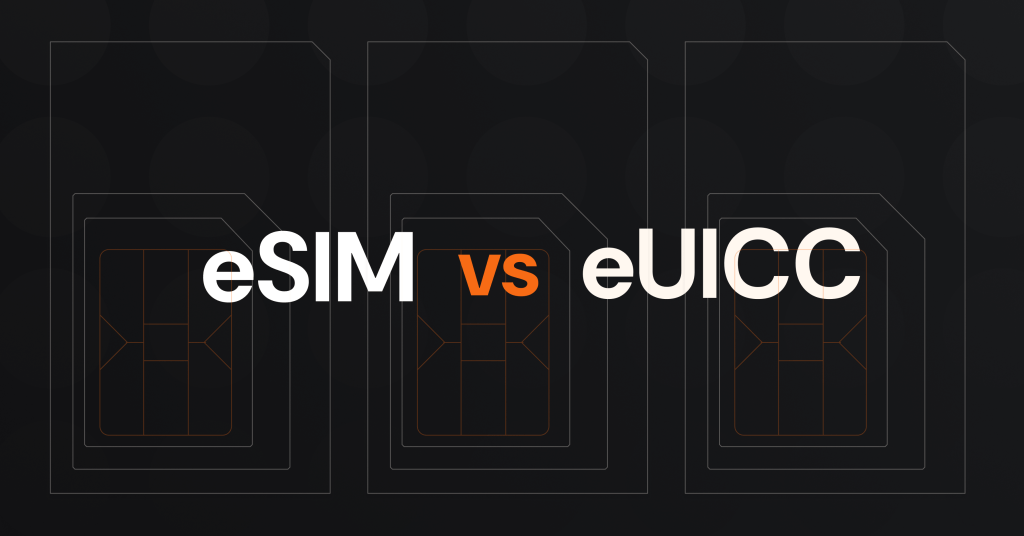
eSIM vs eUICC: Why the terminology is confusing
The term eSIM is commonly used to describe two different (but related) concepts:
- An embedded SIM form factor (hardware)
- The eUICC architecture (software)
While GSMA formally defines eSIM as the eUICC specification, most IoT vendors and operators bundle the term with the MFF2 embedded SIM chip, which has led to widespread confusion.
In practice, SIM hardware and SIM software are independent choices, and understanding that distinction is critical for IoT deployments.
What is an eSIM (embedded SIM)?
At the hardware level, an eSIM refers to a non-removable SIM chip that is soldered directly onto a device’s PCB, typically using the MFF2 form factor.
Compared to removable SIM cards, embedded SIMs offer:
- Improved durability and vibration resistance
- Smaller footprint
- Better suitability for harsh or sealed environments
This makes eSIM hardware ideal for industrial, automotive, and long-lifecycle IoT devices.
However, being embedded does not automatically mean the SIM supports eUICC.
Understanding SIM form factors (hardware)

The image above shows how SIM cards have evolved significantly over time, but it is important to understand that these form factors determine physical size and installation, not functionality.
You can run UICC or eUICC software on most form factors, from nano-SIMs to embedded chips. The form factor alone does not define whether a SIM can store or switch multiple operator profiles.
What is eUICC?
eUICC (Embedded Universal Integrated Circuit Card) is software architecture that enables a SIM to store and manage multiple operator profiles.
Instead of being locked to a single carrier, an eUICC SIM can:
- Download profiles remotely
- Switch between them over the air (OTA)
- Avoid manual SIM replacement
In simple terms, eUICC turns a SIM into a container for multiple UICC profiles, controlled by an eSIM management platform.
Importantly:
- You can also have an embedded SIM without eUICC
- You can have eUICC on removable SIMs or embedded SIMs
UICC vs eUICC for IoT
UICC (Universal Integrated Circuit Card)
UICC is the most widely deployed SIM software standard today. It supports:
- 2G, 3G, 4G, 5G
- LTE-M, NB-IoT
- LTE Cat-1 bis
However, a UICC SIM can only contain one operator profile, which historically made global IoT deployments vulnerable to:
- Permanent roaming restrictions
- Coverage gaps
- Regulatory limitations in certain countries
eUICC
eUICC addresses these limitations by enabling remote profile provisioning.
This allows IoT devices to:
- Change operator profiles without physical access
- Rotate profiles to comply with roaming regulations
- Adapt connectivity after deployment
But these benefits come with trade-offs.
The hidden costs of eUICC in IoT deployments
1. Limited profile capacity
eUICC SIMs support multiple profiles at a time, depending on the SIM storage. While profiles can be deleted and replaced, this process:
- Requires data
- Consumes power
- Adds operational complexity
For mobile or unpredictable deployments, this limitation can become a bottleneck.
2. Higher power and data consumption
With SGP.22, the eSIM consumer technical specification that smart phones implement, profile management happens on the SIM itself.
Switching profiles involves authentication processes and communication with subscription managers.
Compared to routing traffic in the core network, eUICC profile switching is significantly more resource-intensive, which matters for battery-powered IoT devices.
3. Technical lock-ins
Every eUICC contains an ECASD (eUICC Controlling Authority Security Domain) created during manufacturing. This record defines which eSIM management platform controls the SIM, and it cannot be changed or removed.
Once deployed, your devices are permanently tied to that platform. Switching platforms later means physically replacing SIMs — an expensive and often impractical task at scale.
4. Commercial lock-ins
Many eUICC solutions involve ongoing costs for inactive profiles, restrictions on profile removals, and mandatory bootstrap profiles. Some providers may charge for the storage or potential activation of these profiles, impacting the overall cost-effectiveness of the IoT deployment.
While bootstrap profiles are useful during provisioning, they often become a permanent commercial dependency, increasing long-term costs.
Onomondo’s approach: global connectivity without profile switching
Most providers use eUICC to move network selection logic onto the SIM.
Onomondo does the opposite.
Instead of switching profiles on the device, Onomondo routes connectivity in the core network.
This is possible because Onomondo has built full core-network integrations with MNOs across 680+ networks worldwide.

What this means in practice:
- One global SIM profile
- One APN
- One network – everywhere
Whether your device connects via Verizon in the US, China Unicom in China, or Telia in Denmark, traffic is routed through Onomondo’s core network. We call this network-agnostic connectivity.
UICC or eUICC — which should you choose?
Both UICC and eUICC can be used across Nano-SIM (4FF) and Embedded SIM (eSIM / MFF2) hardware.
eUICC’s main advantage is profile switching, which can help in specific regulatory scenarios. But that advantage comes with higher complexity, power and data overheads, and long-term lock-ins.
With Onomondo, many IoT deployments that would traditionally require eUICC can operate perfectly on UICC, while still accessing 680+ local networks across 180+ countries.
And for use cases that do require eUICC, Onomondo can also be deployed on top of eUICC, delivering the same global reach — without forcing you into platform or commercial lock-ins.
Future-proofing IoT connectivity
Global IoT connectivity doesn’t have to mean complex SIM logic, multiple profiles, or long-term constraints.
By centralizing routing in the core network and removing unnecessary dependencies from devices, Onomondo simplifies large-scale IoT deployments — today and in the future.
Onomondo provides a single, global IoT network designed specifically to reduce operational overhead, regulatory risk, and long-term cost.