

NTN is the tip of the spear in connectivity technology right now. The main enabler for 5G, NTN brings in a lot of novelty, and with it advantages and challenges – even more so in the IoT space. So, let’s explore NTN: What it is, what you can gain from it, and what to look out for when designing IoT projects with NTN in mind.
Table of Contents
What is NTN?
NTN stands for Non-Terrestrial Networks. It is a network technology that connects devices via satellite or other airborne platforms, such as drones, balloons, and low-altitude platforms. The difference from the cellular, terrestrial networks, like 4G, LTE-M, and NB-IoT, is that devices connect directly to the satellite instead of a ground tower.
Why is NTN important?
NTN technology has arrived with a big promise: to provide network coverage to every square meter on Earth, beyond the reach of ground towers. NTNs are important because they enable high-speed, high volume data connections and full compatibility with existing terrestrial networks.
These capabilities are lucrative, especially in IoT use cases like surveillance and monitoring, sensing mechanisms, and maritime or airborne communication. However, it is critical to note here that, as of early 2026, when someone mentions Non-Terrestrial Networks in the context of IoT, they are primarily talking about NB-IoT connectivity.
In the case of 5G, NTNs are essential for features that require an always-on connection, such as autonomous vehicles, supply chain tracking, remote control and monitoring, and emergency communications. In these cases, the continuity provided by NTNs ensures a constant connection outside of the cellular range.
What are the different kinds of NTN?
There are a few distinctions within Non-Terrestrial Networks. The two main ones are distinguished based on a) signal processing mode, and b) altitude.
Regenerative payload (on-board processing) VS Non-regenerative payload (bent-pipe)
A regenerative payload NTN –also called non-transparent mode or on-board processing – acts like a data center. When it receives a signal from the device, it processes it before it sends it back.
A Non-Terrestrial Network with non-regenerative payload mode –also called bent-pipe payload or transparent payload– does not read or process the signal – it only receives it and sends it back to Earth verbatim.
Each of these two technologies have their own pros and cons. Non-regenerative mode is compatible with terrestrial networks like 4G and 5G, and the hardware is cheaper. However, it also has higher latency and requires larger and more powerful ground stations.
On the other hand, regenerative mode has lower latency, performs better with weaker signals, and because it is remotely programmable, it can scale better with more users or types of hardware. On the con side, upgrading a satellite in regenerative mode is more complex, as the hardware is in higher altitude –if not in actual space– and significantly more expensive.
Altitude & Orbit class
It bears repeating, not all NTNs refer to satellite connectivity. Several means enable non-terrestrial connectivity and they operate on different altitudes, from the troposphere to the exosphere. Let’s take a look starting from closest to furthest away from the ground.
Low altitude platforms (LAP)
LAPs operate within a range of 500 meters to 5 kilometers and provide temporary or localized coverage.
High-Altitude Pseudo-Satellites (HAPS)
HAPS operate in the stratosphere at approximately 20 km and above the weather, to provide wide area coverage with low latency.
Satellite
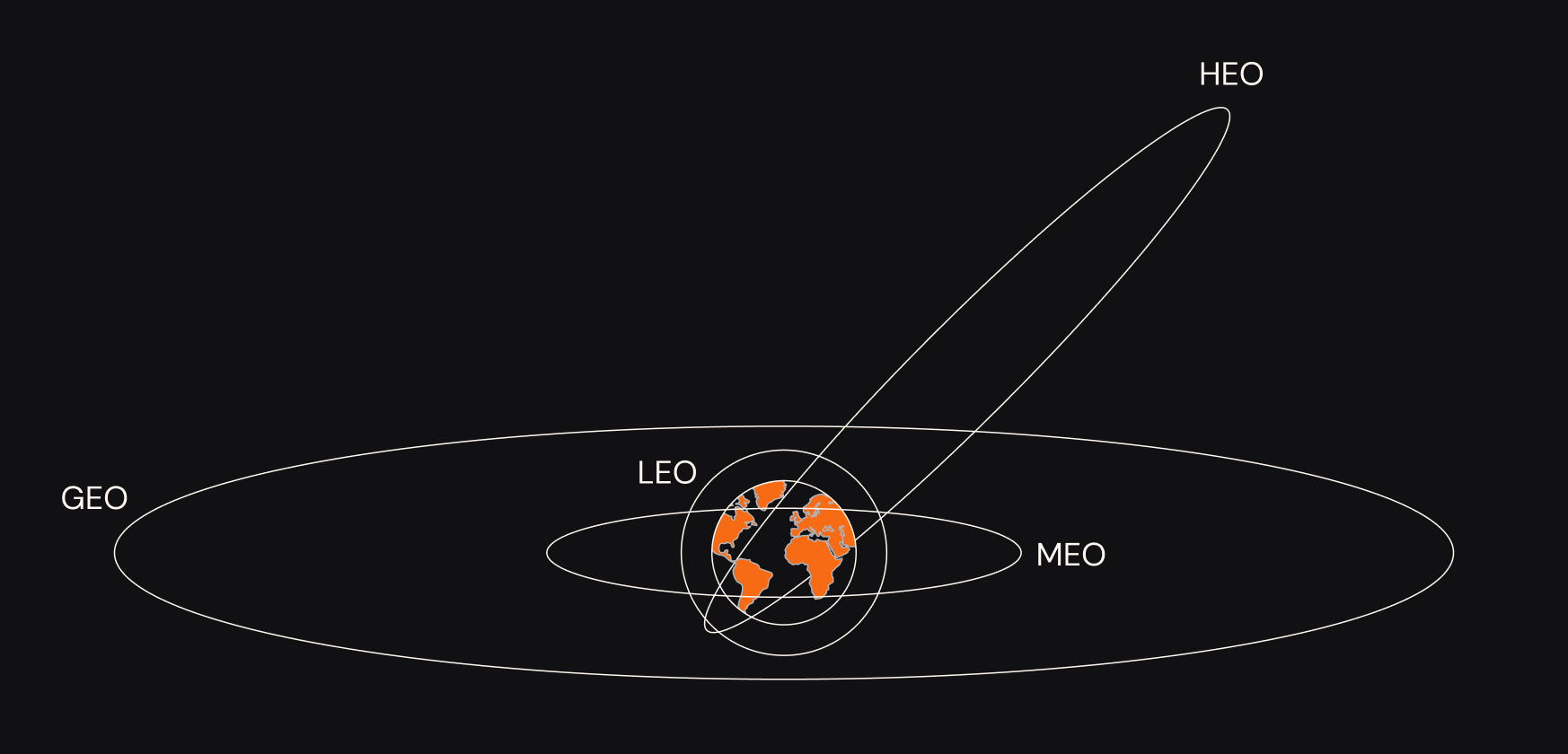
Satellites are the primary delivery mechanism for Non-Terrestrial Networks. They provide global coverage with high resilience. Satellites have an additional altitude class based on their orbit [1]
- Low Earth Orbit (LEO): Orbiting between 200-1,600 km from Earth’s surface, LEOs are typically used for rescue missions, data transfers, and location-based services.
- Medium Earth Orbit (MEO): With a distance from Earth between 10,000-20,000 km, MEO satellites are orbiting between LEO and GEO.
- Geostationary Earth Orbit (GEO): GEO is the highest circular orbit with a 35,000 km distance from Earth. Due to the orbit height, GEOs provide larger coverage areas compared to LEO and MEO.
- Highly Elliptical Orbit (HEO): Orbiting in an ellipsis, HEO is also referred to as Extremely Elliptical Orbit (EEO).
Terrestrial Networks vs Non-Terrestrial Networks
Besides the hardware involved in TNs and NTNs, there are a few additional differences between using each kind of technology.
1. NTNs have higher latency than TN
Because the signal has to travel much further and at a much higher altitude compared to the closest (or preselected) tower, the latency is longer and the speed may be affected.
2. NTN cells are larger than TN
The areas NTNs cover span thousands of square kilometers as opposed to cellular networks, and while that remains a main benefit of NTN, it affects the signal speed and the density of devices in a geographical area. Depending on how close to or far from the satellite the device is, the signal may arrive at different times, and the larger range complicates the radio design of the device.
3. NTNs are affected by the atmospheric layers
The layers of the atmosphere are impacted by either sun particles or the weather, that in turn can affect the signal depending on the frequency. For NTN platforms in the troposphere, like LAPs, high frequency signals (above 10GHz) may be weakened by the weather conditions. Hardware in the ionosphere is a hurdle for the lower frequency signals (below 6GHz) most frequently used in IoT, as they can be bent, faded, or distorted, or faded by the sun particles.
Benefits and limitations of Non-Terrestrial Networks
The telecommunications world has welcomed Non-Terrestrial Networks warmly and with high expectations. It is no wonder, since the NTN promise is massively significant. NTNs provide seamless, uninterrupted coverage in remote areas and across the sea or air – areas that have long struggled with consistent terrestrial connectivity. Moreover, some use cases simply cannot be materialized without the guarantee of constant, ubiquitous connectivity of NTNs.
NTN: Challenges and considerations
But as with every new technology, NTNs present some challenges still. There are justified answers to the question “why aren’t NTNs everywhere connecting everything?”.
1. Price of NTN
Starting with the most important point, non-terrestrial connectivity can be 2 to 6 times more expensive per device compared to terrestrial networks. Looking at a typical wholesale cost for telematics, according to Berg Insights, the wholesale cost per device is approximately €0.50. Comparatively, NTN NB connectivity can cost from €1 minimum for very low usage, the SIM and 1-2Kb, up to €2-3 for small MB worth of usage.
2. Inaccessible infrastructure
Once deployed, NTN hardware equipment is either completely or highly inaccessible; if there are any hardware issues, troubleshooting and repairing them is no small feat. Among other things, this is the result of NTN infrastructure and hardware being hugely expensive to develop and deploy.
Moreover, NTN equipment issues are not uncommon and reasonably so. Satellites and other NTN platforms operate in harsh environments, under extreme weather conditions, temperatures, and exposure to additional radiation.
3. Connection latency, variation, and handovers
Satellites in particular are in constant motion, especially those in low-earth orbit. This movement affects the connection quality in two important ways.
3a) High energy consumption
As the satellite is moving faster relative to the device on the ground, the signal frequency of the signal can stretch as it arrives. This is called Doppler shift, and it requires the device radiomodule to work harder to remain aligned with the satellite’s changing signal. The device needs additional logic in its GNSS module to open the connection at the time when the satellite is passing by the device.
While the NTN promise is seamless and continuous connectivity, the doppler shift means that in reality, the connection can either fluctuate more compared to a fixed cell tower or the device will have a diminished life span due to higher energy consumption.
3b) The network paths keep changing
As satellites are in orbit and in constant movement, devices frequently switch from one satellite to the next – often every few minutes. In a terrestrial connectivity scenario, handovers between towers are predictable. But in a non-terrestrial case, the handover process is far more dynamic. These constant changes in routing can have an impact on the connection:
- Variations in signal delay, because the path to the network is always shifting.
- Increased risk of dropped connections because of frequent handovers and especially for devices that move or operate in challenging locations.
This variability is a core limitation of NTN: even though coverage is global, the stability of the connection can be harder to guarantee.
4. Compliance
The non-terrestrial nature of NTN is an additional regulatory hurdle that has yet to be scoped fully.
Firstly, satellites cross many physical borders and legal jurisdictions. Who controls the signal, how the satellite is controlled when it passes a region, whether it is allowed to even operate over certain regions, and how governments choose to regulate or monitor NTN equipment have multiple, fragmented answers.
In addition, licensing radio spectrum and coordinating frequencies across countries is a complex operational landscape that often results in higher costs.
IoT-specific challenges with NTN connectivity
Not all existing IoT devices are NTN-ready. IoT devices must fulfill certain specs in hardware and software to connect to a Non-Terrestrial Network, starting with the most important aspect:
1. Line of sight requirements
Line of sight is a fundamental challenge for Non-Terrestrial Networks and one that removes a large share of existing IoT use cases. To connect to a satellite, an IoT device must have a clear, unobstructed path to the sky. While terrestrial cellular network signals can often penetrate walls, reflect off buildings, or bend around obstacles, satellite signals arrive at much lower power levels and cannot tolerate blockage.
This becomes even more pronounced when satellites are low on the horizon, where signals must travel through more atmosphere and encounter additional obstacles. As a result, many IoT use cases are poorly suited for NTN, e.g., indoor sensors, underground devices, and devices embedded in machinery.
To overcome line-of-sight constraints, devices designed for NTN connectivity often require external antennas, careful placement, or redesign, raising installation complexity and cost.
2. Antenna
The distance between a device and the satellite is much, much bigger than the distance between the device and a ground radio tower. Hence, a more powerful antenna is required to cover this distance. And “more powerful” in this case can take many forms: NTN connectivity may require multiband antennae and in some cases, external placement, affecting the size and the design of the device.
3. Communication protocols
Satellite connections are slower, more variable, and have higher latency. IoT software must be designed to handle these limitations gracefully. This means that the communication protocols should be lightweight (think CoAP, MQTT-SN, or DTLS), the data packets should be small, and the chatter should be minimal. Without these, you may be running the risk of dropping packets, draining the battery of your device, or adding unnecessary data costs – that, in the case of NTN, won’t be slim.
4. Battery life
Sending a signal to a satellite takes significantly more energy than sending it to a ground tower. Additionally, in the case of LEO networks, because a LEO satellite is only overhead for short windows, the device has to search for satellites and retry connections frequently. This means even higher power consumption. To put it simply, high sophistication connectivity is not the most economical for an IoT device battery.
5. Release 17-conforming and NTN-compatible modems and modules
NTN support requires chipsets that implement 3GPP Release 17 (or later). Today, few modems support this and they are still more expensive than their TN-compatible counterparts. In the case of tracking, supporting NTN may also require GNSS modules that understand satellite bands and new timing requirements. This increases the bill of materials (BOM) for every device.
6. Higher IoT device BoM overall
Between advanced antennas, specialized chipsets, more sophisticated GNSS, and additional energy management, NTN-capable IoT devices quickly become more expensive to build. As We Speak IoT puts it, satellite IoT “increases device cost due to specialized chips and antennas.” This is a core reason why large-scale IoT projects are waiting to adopt NTN today.
Why isn’t IoT NTN mainstream already?
NTN has the IoT industry excited – and with that promise, rightfully so. But the 2026 reality is that it is still a niche. Today, NTN for IoT mostly supports NB-IoT connectivity and the use cases are limited to small data payloads.
In the majority of cases, NTN connectivity works best as a complement to terrestrial networks, not a replacement. Several practical barriers slow down mainstream adoption.
1. Physics make NTN harder
The physical distance between NTN equipment and terrestrial devices creates very high path loss, far higher than in terrestrial networks. Small, battery-powered IoT devices struggle to send signals that are strong enough and stable enough.
2. The integration with existing technologies is not seamless yet
A major promise of NTN is that devices would connect without proprietary hardware and integrate with terrestrial networks. This promise was examined in a recent, peer-reviewed study and found that NTNs deliver – under conditions. The researchers studied the integration of NTNs –LEOs in particular– for 5G NR and assessed the performance of 5G NTN.
They conclude that LEO constellations successfully deliver on the promise of continuous coverage, especially for moving devices. The main challenges in achieving higher data rates are the limited spectrum bandwidth and interference.
And there’s the device component part of it. In reality, a usable standards-based NTN that works with common cellular chipsets is still not widely available. Early implementations support only NB-IoT, and even then with limited features. More capable modes like LTE-M, Cat-1, and higher-throughput 5G NTN are still under development.
3. The ecosystem is still fragmented
Few modem vendors support NTN-ready modules today, and the chipsets that do exist are cutting-edge technology. The prime example is Nordic Semiconductor’s brand new nRF9151 that supports NTN connectivity.
This means that your entire device should be built with equally cutting-edge components: Antenna requirements are stricter. Firmware and device design must adapt to long delays, variable links, and tighter link budgets. On the network side, satellite operators, ground stations, and regulators are not yet aligned.
Verdict: NTN is a complement to cellular – not a replacement
Many IoT deployments already are within reliable terrestrial coverage. In these cases, NTN adds little value but lots of cost. NTN is a considerable technology in some cases when devices leave land-based networks: At sea, on air, or in remote areas. For now and with all costs considered, this means that NTN is appropriate to fill coverage gaps, but is still not a financially viable replacement to cellular connectivity.
Should you use NTN for IoT?
Obviously, the answer is more nuanced than yes or no. Ultimately, it depends on your use case. Some use cases within remote monitoring in rural areas, disaster response, and maritime are well suited for NTN and can see ROI from using it. However, even in these cases, NTN may be fully beneficial as a fallback network.
What we at Onomondo observe is that, in 2026 and in 19 out of 20 cases, TN cellular is still a better business case and the safe bet, as a stable, established, and resilient technology. However, in the one remaining case where NTN is truly appropriate, cellular can’t compete.
So before you commit to NTN, do your due diligence to see if your use case is indeed the one out of 20. Start with an ROI assessment and consider at least 3 scenarios: 1) fully cellular, 2) cellular with NTN as a fallback, 3) fully NTN. Assess the costs, the benefits, and the long term viability of the project, accounting for the device lifetime, power budgets, connection frequency, and the regulatory landscape.
As a pleasant surprise, your IoT project may turn out more affordable than initially planned.
[1] Penttinen, J. T. J. (Ed.). (2015). The Telecommunications Handbook: Engineering guidelines for fixed, mobile and satellite systems. John Wiley & Sons.