IoT SIM
06.03.2026

What is an MFF2 SIM? A practical guide for IoT deployments

MFF2 is one of the most widely discussed embedded SIM form factors in IoT, but it’s often misunderstood. This guide explains what MFF2 is, how it compares to other embedded options, and what it means for connectivity in practice.

What is an MFF2 SIM?

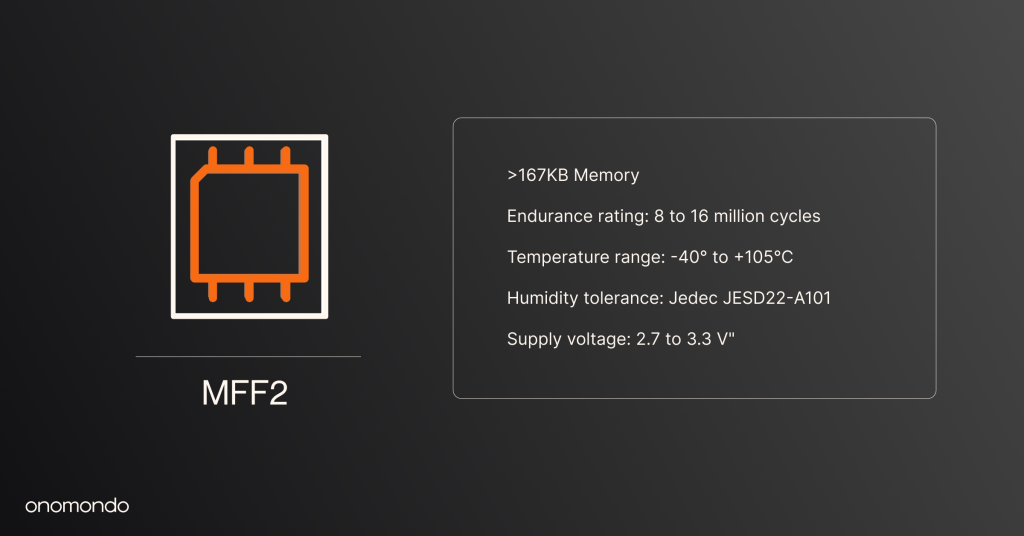
MFF2 (Machine Form Factor 2) refers to a specific physical format of an embedded SIM. Instead of a removable card, the SIM is soldered directly onto the device’s PCB during manufacturing. It becomes a permanent part of the hardware, with no tray, no slot, and no physical access once deployed.

It’s often described as an “eSIM,” but that’s not quite right. MFF2 defines the form factor – whereas eUICC (often called eSIM) defines the capability to manage profiles remotely. The current trend is that modern MFF2 SIMs support eUICC, but the two are not the same thing.

In practice, MFF2 is the standard form factor for IoT devices that need to operate reliably over long periods without human intervention.

Why MFF2 is used in IoT

Embedded SIMs such as MFF2 solve a set of very practical problems that removable SIM cards were never designed for. IoT devices are often sealed, deployed in difficult environments, and expected to run for years without maintenance.

By removing the physical SIM interface entirely, embedded SIMs improve durability and reduces failure points. There are no connectors to wear out, no risk of SIM removal, and no need to access the device after deployment. This is critical in environments like industrial equipment, vehicles, or outdoor infrastructure.

It also simplifies manufacturing. The SIM is integrated during production, so devices leave the factory fully assembled and ready for connectivity. There is no manual SIM insertion step, which reduces complexity and improves consistency at scale.

Over time, this becomes a lifecycle decision as much as a hardware one. If a device is expected to operate for 5–15 years, the SIM needs to be as reliable as the rest of the system.

Comparing embedded SIM form factors: MFF2 vs MFF-XS vs iSIM vs SoftSIM

MFF2 sits in the middle of an evolving hardware landscape. Newer form factors and approaches are emerging, but they each come with trade-offs.

MFF-XS

MFF-XS follows the same principle as MFF2, but in a smaller package. It’s designed for highly space-constrained devices, such as wearables or compact sensors. In theory, it offers the same capabilities in a reduced footprint. In practice, adoption is still limited. The ecosystem is less mature, and most modules and manufacturers continue to standardize around other form factors.

iSIM

iSIM takes a different approach. Instead of requiring a separate SIM component, iSIM integrates SIM functionality directly into the device’s main system-on-chip (SoC). This reduces board space and can improve power efficiency by removing the need for a discrete SIM chip.

However, this level of integration introduces new dependencies. Because the SIM functionality is tied directly to the chipset, the SIM lifecycle becomes closely linked to the chipset vendor. This can limit flexibility when managing connectivity providers or updating provisioning models over time. For deployments operating across multiple regions and networks, that tighter coupling can become a consideration.

SoftSIM

SoftSIM takes integration even further by implementing SIM functionality entirely in software rather than in a dedicated hardware element.

In this model, device identity and authentication are handled by secure software running on the device.This approach offers advantages in terms of hardware simplicity and manufacturing flexibility, since no physical SIM component is required.

Learn more about the Onomondo SoftSIM

Where MFF2 fits today

Among these options, MFF2 represents a well-established embedded SIM form factor with broad industry support. It works across many existing cellular modules and manufacturing workflows, making it a practical option for device manufacturers looking to integrate connectivity directly into their hardware.

While interest in newer approaches such as MFF-XS, iSIM, and SoftSIM continues to grow, MFF2 remains a familiar and widely supported choice for teams designing connected devices today.

How connectivity works on MFF2 sims

The form factor defines how the SIM is installed, but not how connectivity is managed. That depends on the SIM architecture.

Multi-IMSI

Multi-IMSI (Multiple International Mobile Subscriber Identities) SIMs store multiple network identities on the SIM. The device switches between them based on location or predefined rules. This provides some level of resilience, but it is inherently limited. The available networks are fixed at the time of provisioning, and adding new ones later is difficult.

eUICC

eUICC (embedded Universal Integrated Circuit Card) introduces remote provisioning. Instead of preloading all network profiles, the SIM can download and switch profiles over the air. This improves flexibility, especially for global deployments, but it also introduces operational overhead. Profiles need to be managed, distributed, and maintained over time.

A note on eUICC: Until recently, remote SIM provisioning with eUICC for IoT was complex. The GSMA SGP.22 eSIM standard designed for consumer devices was limited for OTA profile updates in network- and location-constrained devices in bulk. With the introduction of SGP.32, the eSIM IoT specification, these issues are resolved and eUICC becomes more accessible for IoT fleets.

Single global profile (cloud-managed connectivity)

Some connectivity providers (including Onomondo) take a different approach by keeping the SIM architecture simple and moving the intelligence into the network platform.

With this model, the SIM uses a single global identity rather than multiple IMSIs or downloadable profiles. Devices attach to available local networks, while routing, network selection, and connectivity management are handled in the cloud.

This reduces the need for IMSI switching or profile lifecycle management on the SIM itself. Instead, connectivity decisions are controlled centrally through the platform.
MFF2 connectivity options compared

Network integration

Refers to the underlying SIM technology: UICC (Universal Integrated Circuit Card), IMSI (the identifier), and eUICC/eSIM (enabling dynamic profile switching).

UICC with multiple IMSIs for network flexibility Embedded UICC (eUICC), also known as eSIM, supports multiple downloadable profiles Standard UICC with a single International Mobile Subscriber Identity (IMSI), integrated with a global core network
Signal strength and reliability

Describes the reliability and quality of the network signal accessed by the SIM, crucial for uninterrupted connectivity.

Varies with IMSI selection, dependent on the coverage of each carrier's network Dependent on the eSIM profile in use, varying by carrier network performance Optimized through a unified core network integration
Data transfer efficiency

Indicates the SIM’s capability to manage data usage effectively, impacting operational costs and data throughput.

Efficiency varies, potentially less optimized due to switching between multiple IMSIs/carriers Profile-dependent efficiency; can be optimized based on the chosen carrier profile Enhanced due to network optimizations, reducing unnecessary data usage
Battery-life optimization

Reflects the influence of the SIM card technology on the device’s overall battery consumption, a critical aspect for IoT devices.

Can be impacted by frequent IMSI switching, potentially increasing power usage Power efficiency depends on the eSIM management system and selected carrier profile Likely better, as network optimizations can reduce power consumption
Deployment and management complexity


Involves the operational complexity of deploying and managing the eSIM, especially in global and diverse network environments.

More complex due to managing connections across multiple IMSIs and carriers Requires sophisticated management for multiple eSIM profiles, but offers high flexibility Simplified with single IMSI, easier to manage across global networks

How MFF2 setup works in practice

From a device manufacturer’s perspective, working with embedded SIMs such as MFF2 shifts connectivity integration from post-production to the manufacturing stage.

The process typically starts during hardware design. Some manufacturers choose modules that already include an embedded SIM. Others integrate a discrete MFF2 SIM alongside the cellular module. The choice depends on how much control they want over connectivity and supplier relationships.

During manufacturing, the MFF2 SIM is soldered onto the PCB as part of the standard assembly process. There is no additional step for inserting or activating a SIM. The device leaves the factory as a sealed unit.

From there, connectivity depends on the chosen provider. In traditional setups, the SIM may include a bootstrap profile for initial connectivity or a set of preloaded IMSIs, with additional profiles provisioned later using eUICC.

With Onomondo, the SIM is preconfigured with a single global profile. When the device powers on, it connects to available local networks without requiring profile downloads or manual intervention. Connectivity is managed centrally through the platform.

This matters most after deployment. Devices can be installed in the field, across multiple countries, without needing physical access for SIM changes or troubleshooting. Updates and optimizations happen remotely, which reduces operational cost and complexity over the lifetime of the device.

When MFF2 is the right choice

Like all embedded SIMs, MFF2 removes the physical limitations of removable SIM cards. It improves durability, eliminates failure points, and allows connectivity to be built into the device from the start. This makes it well suited to devices that are sealed, deployed remotely, or expected to operate over long periods.

Compared to other embedded options, MFF2 offers a mature and well-supported approach. It works across a wide range of modules and manufacturers, fits into established production processes, and avoids tight dependencies on specific chipset vendors. Newer approaches like MFF-XS and iSIM reduce size further, but they also introduce trade-offs in ecosystem support and implementation complexity.

Get started with simpler IoT connectivity

If you’re building connected devices, the goal isn’t just to embed a SIM. It’s to reduce complexity over the lifetime of your deployment.

Onomondo removes the need for multi-IMSI management and profile switching by using a single global SIM profile with cloud-based control. Devices connect to available networks from the moment they power on, and connectivity is managed centrally through the platform.

Start testing Onomondo for free

Ready to experience next-generation IoT connectivity? Create an account, explore the platform, and start testing Onomondo’s IoT SIM cards for free.

Related articles

Read more about the topic

Interview with Said Gharout, Chair of the GSMA eSIM Working Group 7 for SGP.32
Articles
Building eSIM IoT: Inside the SGP.32 Working Group with Saïd Gharout
A guided tour of GSMA SGP.32, the long-awaited eSIM IoT standard specification, from Saïd Gharout, Chair of the GSMA SGP.32 Working Group.
eSIM vs eUICC
Articles
eSIM vs eUICC for IoT: What are the differences?
Take a practical look at eSIM and eUICC, and learn how UICC, eUICC, and MFF2 affect the benefits and limitations of eSIM in IoT.
SoftSIM vs eSIM vs iSIM
Articles
SoftSIM vs eSIM vs iSIM: Comparing modern SIM form factors
Understanding new SIM standards is important for future-proofing IoT solutions. Learn about eSIM vs iSIM and the world’s first fully virtual IoT SIM, SoftSIM.