

Table of Contents
What is eUICC?
eUICC stands for Embedded Universal Integrated Circuit Card.
eUICC is a logic architecture (software) that runs on a chip in SIM cards –the physical object– and stores multiple subscriber identities. eUICC is not the physical object itself. It is the software on the card that stores multiple profiles and enables users to manage them remotely and digitally.
Important note:
eUICC should not be confused with the embedded SIM card, the non-removable physical form factor, known as MFF2, that is soldered onto a circuit board.
eUICC is the software that stores multiple profiles and enables users to control them remotely. The e in eUICC refers to the embedded functionality of storing and enabling management of multiple profiles – not the embedded chip.
Dive deeper: eUICC vs eSIM
The eUICC is the technical evolution of the UICC. Understanding the benefits and limitations of the UICC, reveals why eUICC was pivotal for IoT, and can help guide your decisions in IoT projects.
What is UICC?
UICC (Universal Integrated Circuit Card) is the logic (software) that stores a single profile in a chip on a removable SIM card. This profile logic consists of IMSI (International Mobile Subscriber Identity), security keys, and network access data, among other things.
The differences between UICC and eUICC are already evident from their definitions. UICC stores a single carrier profile and the entire chip needs to be physically removed to change profiles.
What works well with UICC
While it is an older technology, the UICC still delivers many benefits. It is a lean and simple logic with a singular path to execution and a unique identity. It doesn’t require too much memory and it supports all networks from 2G to 5G. This simplicity makes the UICC SIM highly standardized with well-earned longevity.
Limitations of UICC – Introducing eUICC
The rigidity that comes with a single carrier profile along with the physical intervention required to swap profiles is what brought eUICC to life. In 2014, the eUICC architectural standard was introduced to remove these obstacles and give users more flexibility. As a result, the main functionalities and benefits of eUICC are that it affords to carry multiple profiles that can be controlled over-the-air.
UICC vs eUICC: Key characteristics
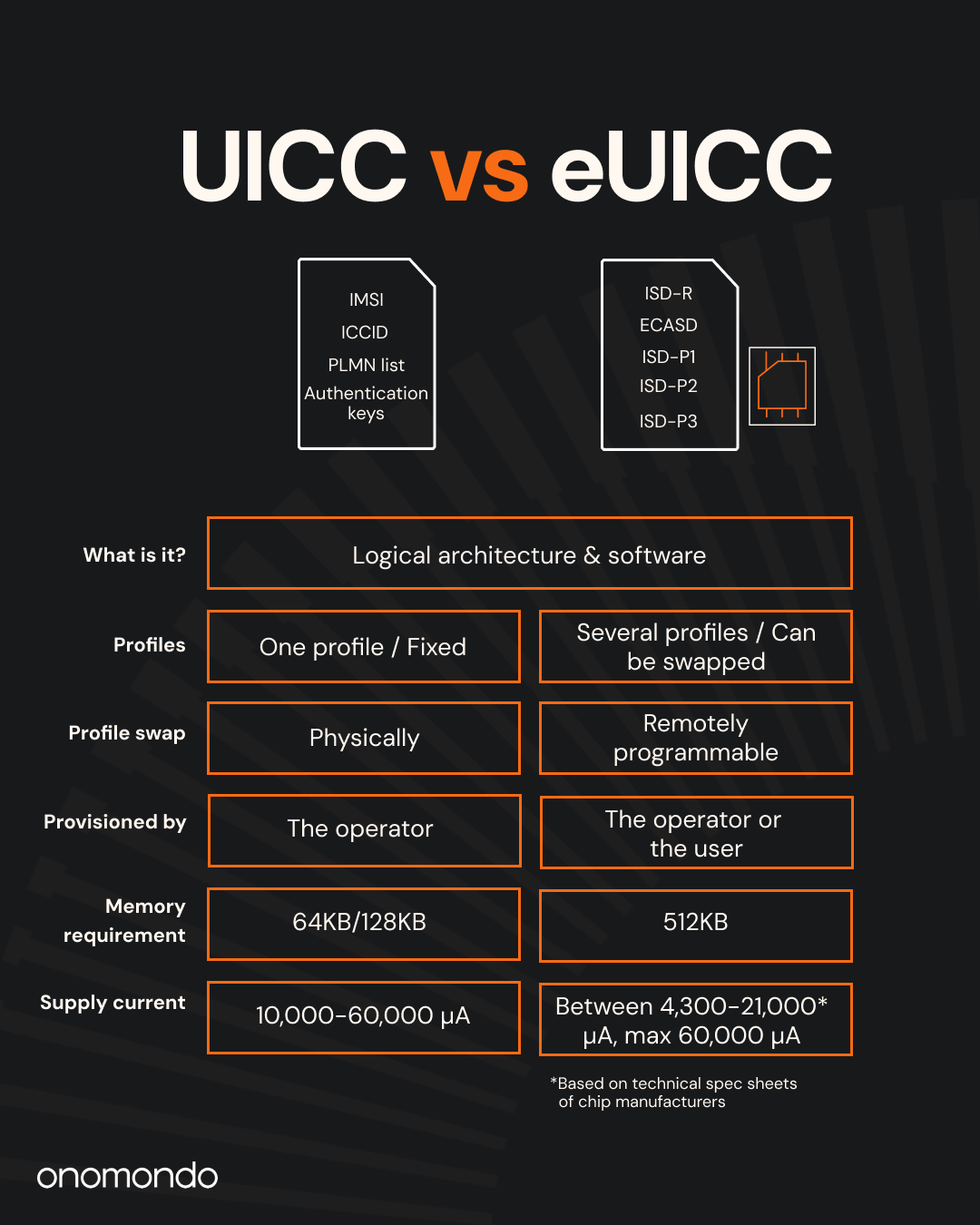
The UICC has a simple logic: it holds a single operator file called International Mobile Subscriber Identity (IMSI), the card identifier (ICCID), the list of preferred networks to connect to (PLMN list), and the subscriber’s keys.
To support remote SIM provisioning and multiple profiles, the eUICC uses a more complex architecture based on several parts:
- ISD-R: The component that manages profiles and communicates with the other parts of the eUICC.
- ECASD: The management application that stores the credentials for authorization purposes.
- ISD-P: Contains a unique profile and each profile has its own IMSI, ICCID, PLMN list, and keys.
| UICC | eUICC | |
| What is it? | Logical architecture & software | Logical architecture & software |
| Profiles | One profile / Fixed | Several profiles / Can be swapped |
| Profile swap | Physically | Remotely programmable |
| Memory requirements | 64KB / 128KB | 512KB |
| Supply current* *In active mode, depending on voltage class | 10,000–60,000 µA | 4,300–21,000* µA, maximum 60,000 µA *Based on technical spec sheets of chip manufacturers |
| Voltage classes | Class A: 4.5-5.5 V Class B: 2.7-3.3 V Class C: 1.62-1.98 V | Class A: 4.5-5.5 V Class B: 2.7-3.3 V Class C: 1.62-1.98 V |
Benefits of eUICC
Simply put, without eUICC, there would be no remote SIM provisioning. Most of us have at least some personal experience of swapping profiles on our phone eSIM. eUICC enables users to avoid roaming charges when traveling abroad or to change carriers easily. Users can enjoy the benefits and cost savings of changing profiles simply by flashing a QR code – no waiting times, no SIM card logistics.
This flexibility and the smooth digital user experience have changed the network carrier paradigm for consumers as well as the B2C business model for Mobile Network Operators (MNOs) and Mobile Virtual Network Operators (MVNOs – MNO resellers).
eUICC challenges, limitations, and gaps in IoT
While the eUICC has been transformative for consumer connectivity, over the years, it presents large gaps for IoT. Over-the-air remote SIM provisioning and profile swaps –the very benefits of eUICC in B2C use cases– don’t work as well for remote devices with time-bound connectivity.
1. SIM profile swapping for IoT with eUICC
Let’s go back to the experience of swapping profiles and providers on a phone eSIM.
- A mobile phone user provisions the SIM profile remotely via a user interface. IoT devices usually don’t have an interface, thus complicating remote provisioning.
- In addition, many IoT devices are not connected at all times – they may wake up at regular intervals to send or receive data packets. As a result, swapping profiles on an IoT device is not as flexible as it is for the consumer.
- Finally, the remote SIM provisioning experience is simple and straightforward on a phone because it happens for one device. IoT devices come in fleets – remote SIM provisioning for hundreds or thousands of devices is not as streamlined. It requires coordination between the current and future operator for the security key exchange to happen in bulk. This process is so cumbersome that not many businesses see value in initiating.
2. Data and power requirements for profile swapping
Swapping profiles is an extremely power- and data-hungry function. In the case of phones and other consumer-facing devices, this appetite for data and energy isn’t a problem. If the device is not on WiFi but on the data plan when it swaps profiles, the data pool will fill up again next month. If the phone battery drains quicker due to the profile swap, the user can access a charging station quickly and easily.
This isn’t the case for IoT. To start with, IoT devices may be scattered across the world – the opportunity to proactively charge them isn’t handy. In fact, the very lifespan of many devices out there depends on the battery life and how energy-efficient the device is programmed to be. Simply put, in IoT, there’s no voltage to spare – especially for such a high-power function as profile swapping.
Moreover, data consumed by IoT is a highly cost sensitive area for its operators. Whether the device is roaming or not, downloading a profile is a significant data packet – often many times larger than what the device consumes over months. Multiply that by hundreds, and you have a cost that makes a real dent in the budget.
Finally, profile swapping is a long process – sometimes too long for many IoT devices that may experience intermittent connectivity or do not stay connected long enough for the process to be completed. The relevant GSMA specifications and architecture (SGP.22) for swapping profiles were designed for devices with stable connectivity and without constraints.
eSIM IoT SGP. 32 – bridging the eUICC gaps for IoT
The limitations of eUICC for IoT devices became evident rapidly. Simply put, IoT devices could not reap the benefits of the eUICC architecture in the same way consumer devices did. That is when GSMA introduced the eSIM IoT architecture and requirements specification, formally known as SGP.32.
eSIM IoT is an improved take on the eUICC option for IoT as it outlines the architecture of remote profile swapping for IoT devices specifically. According to SGP.32, the entity managing the device (eIM) also manages the profiles, as opposed to the previous eSIM specification, SGP.22, where the user still has to ask the operator to push the profile into the eUICC.
The SGP.32 standard for eSIM IoT introduces the processes and architectural components for independent user profile management, for IoT devices without a user interface and outlines the data and power constraints to swap profiles in a quick and easy way.
While the details of SGP.32 merit a few thousand words of their own, the key takeaway in the context of eUICC for IoT is this: It’s no wonder that eSIM IoT is anticipated with excitement. When eUICC was introduced, the IoT world was looking forward to the opportunities of remote SIM provisioning, but experienced the limitations quickly. In 2026, eSIM IoT is still in the very early stages of rollout. The demand is high but the supply is not at corresponding levels yet.
What type of SIM should I choose for IoT devices in 2026?
Today, a global IoT SIM with multiple IMSI technology can deliver on the eUICC value of swapping networks remotely. Global IoT SIMs support connections with several carriers as they simply store several subscriber identities.
A tried and tested technology that is highly beneficial for IoT devices, a global IoT SIM card is a closed system that comes loaded with multiple carrier subscription profiles. These profiles can’t be altered, but the user can still swap carriers via their provider’s platform.
The difference with eUICC is that parts of the logic are moved onto the core network, to relieve the device from running redundant logic and still deliver the flexibility to select operators and avoid roaming charges. Moreover, moving the logic from the SIM card to the core network keeps IoT devices leaner and more efficient, and makes the SIM form factor and logic architecture questions far less relevant.
Wrapping up
Two points stand out from the history of eUICC:
- Users –regardless of whether they operate IoT devices or not– need the flexibility to swap networks – and do it as easily as possible. They want flexibility and control of their connectivity.
- IoT Connectivity has been a bit of an afterthought in the telecom industry. That’s perhaps why IoT users cherish all the technological developments focused on IoT and are very quick to seek out the next new thing – be that eUICC in 2014 or SGP.32 in 2026.
However, the IoT space is made up of resourceful, persistent engineers who will find a way – we’re speaking from experience here! So, when it comes to enjoying the benefits of different networks in IoT fleets, there is a solution that enables you to deploy lean, flexible devices globally tomorrow: Global IoT SIMs.